
Announcement - Reviving the Blog
Dear Readers,
It's close to two years since I did anything with this website. In fact, the whole website was a state of stasis since September 13 of 2024. One could have even gone as far to say that this site was dead.
But I'm reviving it.
What happened the past two years? Well, among other things, I focused on completing my coursework for my M.A. in the Bible and the Ancient Near East program at the Rothberg International School of the Hebrew University in Jerusalem. Without dwelling on the details, the studying and workload that came becoming a post-graduate student devoured most of my time, and I sadly neglected this site during that time.
I have not technically finished my degree program yet. HOWEVER, I completed all the coursework for the program, and I am wrapping up the final requirements necessary for me to officially graduate.
With more free time on my hands, I decided that this summer I would finally resume updating this website.
And what better date than today, July 29, the day that, three years ago, I first saw "Barbie"?
Now, to be fair, it is actually July 30, 2026 in Jerusalem, where I am currently writing this. HOWEVER, when factoring in the time zone difference between Jerusalem and the U.S. East Coast, about now is the time that, three years ago, I saw "Barbie" in theaters.
Given the themes of spirituality, religion, gender, and individual exaltation that I have explored both in this website and my graduate studies, it seems intuitive for me to share some of the essays I wrote for classes that I took in the past two years.
So, as part of today's resumption of this website, I'll be posting two essays that I wrote earlier this year. The first, which can be found below, was written for a class titled The Jacob Cycle in the Book of Genesis and focuses on the character of Dinah in Genesis chapter 34. The second, which I will paste in a separate webpage, was written for a class titled Expectations of the End in Late Second Temple Judaism and explores different ancient forms of Messianism.
Now, will I be regularly updating this website?
Maybe.
Honestly, I'm not committing myself to anything - It's been close to two freakin' years since I touched this website, so I'm not promising anything to anyone in regards to the site.
Regardless, I do plan to continue keeping this site and adding content to it (at whatever pace I choose to).
Seeing "Barbie" and the character of Blonde Ken had a notable effect in my decision coming to Jerusalem to studying the history and origins of the Biblical texts and the religions that developed out of them. I am writing with a view of the Old City of Jerusalem to my left. As I write this and glance towards the Temple Mount, I can't help but think that I perhaps wouldn't be here right now if I hadn't seen "Barbie" by a sort-of-accident three years ago (if it weren't for the "Barbenheimer" phenomenon, I wouldn't have bothered to see it).
But I did see it, and here I am.
I'm not sure what my future entails, but let's see where I end up going.
Wishing you all the best,
D.S.
Daniel Silverman
1:20 am, July 30, 2026 Jerusalem Time/
6:20 pm, July 29, 2026 EST
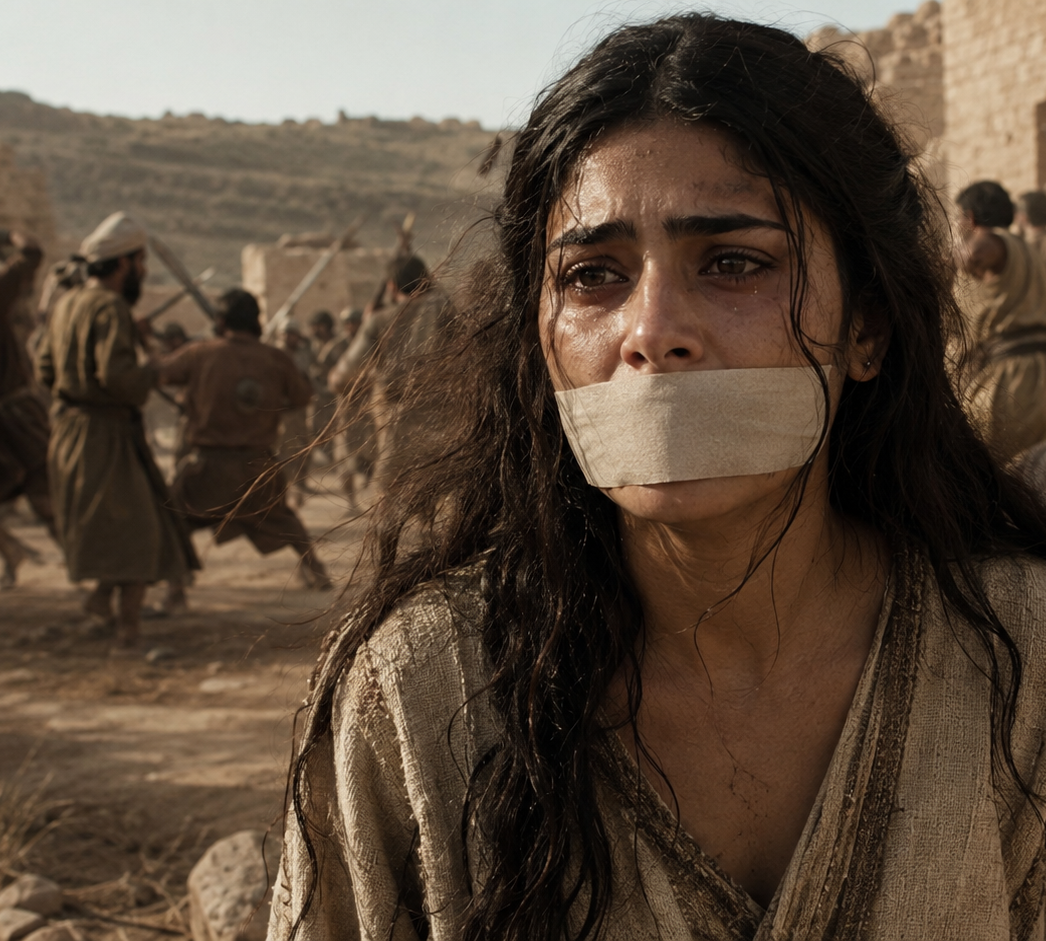
Shout out to ChatGPT for generating this image that imagines a literally speechless Dinah with her brothers fighting the Shechemites in the background.
The Sound of Silence: Dinah as the Emblematic Female Figure for the Ancient Israelites
By Daniel Silverman
Written on April 27, 2026
Introduction
“Hello darkness, my old friend. I’ve come to talk with you again.” These are the opening words of the song “The Sound of Silence” by Simon & Garfunkel. Since its release in 1964, there have been many interpretations as to the underlying meaning of the song. For the purposes of this essay, we will focus on how the song focuses on the idea that silence and darkness, rather than being the absence of words and light, instead offer alternative sounds and sights to comprehend. As demonstrated by the lyrics such as “People talking without speaking” and “And echoed in the wells of silence,” Paul Simon and Art Garfunkel beg their listeners to consider how prolonged silence represents untold, unexamined stories rather than the absence of any narrative.
It is precisely through the notion of the “sound of silence” that we should understand the story of Dinah in chapter 34 of the Book of Genesis. Dinah not only plays the role of pivotal plot mechanism of Genesis 34, but the text mentions her in the majority of the 31 verses in the chapter (Scholz 2001, 11). Yet, she never speaks. Not a single word.
Nonetheless, the absence of any comments or narration by Dinah speaks volumes about her position in Jacob’s burgeoning clan and how the Biblical text treats her as a woman. In fact, the Hebrew Bible’s relegation of Dinah as a silent figure instead of a vibrant and vocal character in other sections of Genesis, such as the Matriarchal figures, allows the reader an insight into how some of the authors of the Hebrew Scriptures ultimately wish for young women to be treated: as objects for leading men to rule and decide over. In other words, the character of Dinah, rather than representing a singular and isolated character, arguably stands in as a proxy for all young women in the ideal society, according to the final redactors and editors of the version(s) of Genesis that humanity has ultimately become familiar with.
Over the course of the many millennia since the Book of Genesis was finalized in its current form, countless texts have been written about Dinah, what occurred to her in Genesis 34, and the ways in which other characters in the narrative reacted. In addition to traditionalist religious commentaries by both Rabbinic Jewish and Trinitarian Christian theologians, we have examples of writings by 19th century German Bible scholars, 20th century American academics, and, more recently, modern feminist thinkers (Scholz 2001, 2–10). In particular, the rise of feminist theory within academia has allowed for newer and more provocative interpretations about Genesis 34, such as whether or not the narrative truly states that Dinah was raped and her role in building early Israelite identity vis-à-vis other inhabitants of the ancient land that the modern State of Israel and the Palestinian Territories currently occupy.
This essay seeks to achieve two primary goals. First, it strives to offer a substantial glimpse into recent debates regarding Genesis 34, particularly around the word “innah” (עִנָּה) in Genesis 34:2 and the role of Dinah in relationship to her brothers. Secondly, upon completing the first, this essay will attempt to argue that Dinah’s character is emblematic of the role of all young women for society in the imagination of Genesis, if not the entirety of the Hebrew Scriptures. Rather than serving as a secondary, minor character for readers of the Biblical canon to gloss over, the explicit violence that is done in her name in reaction to her relationship with an outsider (be it rape or ambiguously consensual) forces us to confront an uncomfortable thesis delivered to us by Genesis: young women are first and foremost tools for men to utilize in the advancement of their power and establishing community dynamics.
Interpreting “עִנָּה”
Traditional interpretations of Genesis 34 narrate that Dinah was raped by Shechem after he encountered her among the “women of the land.” (“התורה,” n.d.) However, this traditional interpretation is staked on a single word: the verb עִנָּה in verse 2. This section will briefly cover various philological examinations of the word, and how modern feminist scholars have used the ambiguity of the word’s meaning to question whether the traditional interpretation is correct in its assertion that Dinah was raped.
Verse 2 of Genesis 34 reads (in the Masoretic text):
וַיַּרְא אֹתָהּ שְׁכֶם בֶּן־חֲמוֹר הַחִוִּי נְשִׂיא הָאָרֶץ וַיִּקַּח אֹתָהּ וַיִּשְׁכַּב אֹתָהּ וַיְעַנֶּהָ
The “Sefaria” website translates this as:
“Shechem son of Hamor the Hivite, chief of the country, saw her, and took her and lay with her and disgraced her.” (“התורה,” n.d.)
The point of contention here is how to best understand the “innah-ed her” component of the verse, which consequently determines whether the chapter narrates an incident of rape on one hand or extramarital seduction that brought social shame to Jacob’s family on the other. As Caroline Blyth wrote in her 2008 doctoral dissertation for the University of Edinburgh, the verb עִנָּה “has probably caused the greatest amount of debate within biblical scholarship regarding the extent of violence used by Shechem during his sexual encounter with Dinah” (Blyth 2008, 54).
First, let us observe how the interpretations that maintain the chapter narrates Dinah’s rape reads the verb עִנָּה. Many of the English translations of the text, including those influenced by German scholars, treat עִנָּה as a word that conveys unwanted force. For example, English translations derived from Gesenius’ work translate the word as the piel form “to weaken a woman, through rape” (.cholz 2001, 8), The Brown-Driver-Briggs lexicon frames the word as to “humble, mishandle, afflict … humble, a woman by cohabitation” (Scholz 2001, 8). Similarly, Mandelkern's classical concordance renders it with the Latin “opprimere, vim afferre” which is an idiom of violent oppression (Scholz 2001, 8). Moreover, Erhard Gerstenberger concluded that the common denominator of the verb’s multiple occurrences in the Hebrew Bible is the application of “physical or psychic force … to alter the status of someone for the worse” (Scholz 2001, 8). Yael Shemesh of Bar-Ilan University situates the word in Genesis 34 within the broader Biblical context of rape incidents, which include the concubine of Gibeah in chapter 19 of the Book of Judges and the rape of Tamar in chapter 13 of the Second Book of Samuel; in both of these cases, the verb עִנָּה consistently signals coercion (Shemesh 2007, 18–20). Thus, in the view of Shemesh, the linguistic and structural parallels of other rape-related incidents in the Hebrew Scriptures to Genesis 34:2 make any reading of Shechem’s interaction with Dinah as one of consensual seduction difficult to entertain (Shemesh 2007, 18–20).
However, starting in the 1980’s, various feminist and revisionist scholars began to examine עִנָּה with greater respect to historical social definitions rather than purely from a philological standpoint. For example, in 1994 Lyn Bechtel argued that עִנָּה should be translated as “humiliated” rather than “raped” given that societies concerned with community honor rather than individual consent included any sexual transgression of social boundaries - including consensual intercourse with men beyond the community – as a type of rape given that the entire community was dishonored (Blyth 2008, 53–58). Similarly Tikva Frymer-Kensky proposed that the verb describes the loss of a woman's marriageable status rather than violent assault (Blyth 2008, 73). Mayer Gruber and Nicolas Wyatt went even further by suggesting that the verb may simply denote sexual intercourse, and that the context of Genesis 34, rather than the word itself, supplies a negative connotation (Shemesh 2007, 4). To the ire of many traditionalists, Ellen van Wolde argued that עִנָּה functions as an “evaluative term in a juridical context denoting a spatial movement downwards in a social sense and should be translated as ‘debase’” (Blyth 2008, 73). The most interesting methodological analysis of the word, however, may belong to Joseph Fleishman, who draws upon Akkadian cognates with Biblical Hebrew to stipulate that Genesis 34:2 reflects the ancient Near Eastern tradition of bridal abductions in which a man would capture a woman of his interest as a negotiating tactic with the woman’s family for eventual marriage (Blyth 2008, 53).
Unlike many of the predecessors in her school of thought, Shawna Dolansky analyzes the word from a philological perspective. Dolansky argues that עִנָּה cannot mean “rape” given its usage in contexts where rape is impossible (Dolansky, n.d.). For example, Sarah does not rape Hagar in Genesis 16:6, but the same verb describes Sarah’s treatment of Hagar. Similarly, YHWH does not sexually assault the Children of Israel during their 40 years of wandering in the wilderness, yet Deuteronomy 8:2 uses precisely this verb to describe the divine purpose of that ordeal. Dolansky even refers to the Yom Kippur instruction to “afflict your souls” (Leviticus 16:31, 23:27, 23:32) for contexts where the Semitic root of עִנָּה cannot be translated for acts of sexual assault (Dolansky, n.d.). Given that the verb cannot mean “rape” in these cases, Dolansky argues the word cannot be inferred to mean rape in sexual contexts, and rather, similar to van Wolde’s argument, should best be understood to denote a downward movement in social status (Dolansky, n.d.). Even more compellingly, Dolansky observes that the Hebrew Bible already possesses a distinct vocabulary for forced sexual assault, as demonstrated with the incident of Tamar’s rape in 2 Samuel 13:14, where the verb pairing חזק + שכב describes how Amnon overpowered and laid with his half-sister (Dolansky, n.d.). Dolansky notes how the same verb חזק appears in Deuteronomy 22:25, which unambiguously discusses acts of rape outside cities (Dolansky, n.d.). Genesis 34:2, by contrast, conspicuously omits any variation of the root חזק, and instead uses וַיִּקַּח (“he took”), וַיִּשְׁכַּב (“he lay”), and וַיְעַנֶּהָ. For Dolansky, the absence of the standard Biblical idiom for forcible overpowering in Genesis 34:2 is philological grounds for readers to dispute the traditional interpretation of rape in Genesis 34 (Dolansky, n.d.).
However, this partly feminist-inspired, revisionist critique of the traditional interpretation has been recently scrutinized in turn by Caroline Blyth. Blyth admits that while עִנָּה certainly carries a range of semantic meanings across sexual and non-sexual contexts, the word’s appearance in Genesis 34:2 is bracketed by the verbs וַיִּקַּח and וַיִּשְׁכַּב, which is the same combination that surrounds the unambiguous rape of Tamar in 2 Samuel 13:14 (Blyth 2008). The argument that Genesis 34 lacks חזק therefore proves less persuasive, according to Blyth, given that וַיִּקַּח itself, particularly when followed by וַיִּשְׁכַּב, can convey forcible seizure rather than mere acquisition, and the constellation of verbs in Genesis 34:2 closely mirrors the vocabulary used elsewhere in the Hebrew Bible where women are violated (Blyth 2008, 71–73). Additionally, Shemesh has noted that nowhere in the Hebrew Bible does עִנָּה describe legitimate sexual intercourse, and that its sexual occurrences cluster precisely in narratives of unambiguous violence (Shemesh 2007, 5). To counter Fleishman, Shemesh makes the valid point that the Near Eastern tradition of abduction-marriage does not exempt such acts from the category of rape, as the sexual encounters that derived from such practices still occurred without the consent of the targeted women; the lack of a woman’s consent, rather than the man’s marital intentions or Near Eastern social tolerances of the practice, determine the authenticity of whether a sexual encounter constitutes rape or seduction (Shemesh 2007, 12–13).
To complicate this debate further, Dolansky herself concedes the limits of her analysis when she writes that “although the text never says that Dinah was forced into having sex, it never says that she engaged in it willingly either” (Dolansky, n.d.). However, it is what Dolansky writes after her concession that strikes at the heart of the problem over Dinah’s role in Genesis 34. Dolansky writes that “the narrator is unconcerned with the question of Dinah’s consent; Dinah herself does not speak a single word in the story” (Dolansky, n.d.).
As this section has demonstrated, a number of feminist and revisionist scholars have challenged the notion that Dinah was raped. At the same time, many religious traditionalists and Biblical scholars (including many women who identify as feminists) maintain that the text of Genesis 34 does state that Dinah was violated against her will, and have vigorously countered recent re-interpretations.
This essay does not attempt to solve this dispute, nor has the means to properly do so. Rather, the dispute over עִנָּה cannot be conclusively resolved on philological grounds alone, and the contentious nature of the debate illuminates a more important fundamental nature of Genesis 34. The scholars who have crafted arguments that criticize the traditional interpretation of וַיְעַנֶּהָ as an act of rape demonstrate to us that we, as readers, are dependent on the view of an unknown narrator. We are never given the chance to hear about the account from Dinah herself.
Moreover, whereas we read in verse 30 Jacob’s reactions to the violence committed by his sons, we have no idea as to what Dinah may have thought. Did she approve such retaliation? Clearly, the text of Genesis has no interest in her opinion.
By relegating Dinah to silence, Genesis 34 instead privileges her brothers, particularly Simeon and Levi, to frame the truth behind the matter. Yet, as the text of Genesis itself admits in the opening verses of 34, Dinah was not accompanied by her brothers when she ventured among “the women of the land”. In the course of denying Dinah the ability to relay her own account of what truly happened to the readers, the text of Genesis strips her of the ability to fully stand as an equal human being to her brothers. Instead, she is subjugated to the role of an object over whom her brothers ultimately have power, as demonstrated in how they decide on the measures of action in response to the Shechemites’ treatment of their sister as “a prostitute.” The fact that they determined that Dinah was treated like a “prostitute” without confirmation or objection from their sister itself demonstrates the absence of any equality on her part.
Feminist and Modern Systems Theory
Having summarized the scholarly debate over the word עִנָּה in Genesis 34:2, we will now turn to an overview of how modern feminist scholars have interpreted the story of Dinah as a reflection of systemic power relations within Jacob’s family.
Irrespective of how one may interpret the meaning behind עִנָּה, Genesis 34 cannot simply be read as an interaction between two individuals. Rather, as modern systems theory and feminist scholars have powerfully articulated, the story presented in Genesis 34 involves different levels of systems and the relationships between them. These systems include not just the dynamics between Jacob’s family and the Shechemites, but the internal dynamics within the nascent Israelite clan, spatial boundaries between different peoples, and senses of religious identity. From a pairing of feminist and systems theory analyses, we can appreciate how the social position that Dinah occupies determines that her silence is not an accidental omission by the narrator, but rather a constitutive feature of the various systems she lives in.
The lack of Dinah’s mention in the chapters leading to Genesis 34 parallel her voicelessness during and following her interaction with Shechem. The “Family as Lived Space: An Interdisciplinary and Intertextual Reading of Genesis 34” article by Reineth Prinsloo and Gert Prinsloo presents a methodological rigorous approach to Genesis 34 through the combined lenses of general systems theory and Henri Lefebvre’s critical spatiality. Drawing on the premise of systems theory that individuals exist within nested familial, social, economic, and political structures that influence each other via continual interaction and adaptation, the Prinsloos construct a family chart of Jacob’s household that illustrates the marginal position that Dinah holds in relation with her kin: that she is the only daughter of Leah, the seventh of Leah's biological children, the eleventh of Jacob's twelve children overall, and, unlike her brothers, receives no etymological explanation or naming speech from her mother (Prinsloo and Prinsloo 2013, 162–69). Moreover, when the clan returns to Canaan in Genesis 32:23, Dinah is not counted among Jacob's “eleven children” (Prinsloo and Prinsloo 2013, 176). When Jacob divides his household before the encounter with Esau in Genesis 33:1–2, she is not mentioned (Prinsloo and Prinsloo 2013, 175). When the genealogies of Genesis 35:22–26 list Jacob's offspring, she is absent (Prinsloo and Prinsloo 2013, 169). As the Prinsloos remark, “Dinah is not conceived, not perceived, and not counted!” (Prinsloo and Prinsloo 2013, 171).
This systemic invisibility helps us explain her silence during the events of chapter 34. The single act for which Dinah is the grammatical subject - her “going out” (וַתֵּצֵא) in 34:1 - is also the act that, to quote Gerhard von Rad, “loosened the stone which became a landslide” of consequences for every system in which she lived (Prinsloo and Prinsloo 2013, 171). Dinah’s decision to visit “the women of the land” involved her leaving one carefully demarcated boundary for another, which represented the crossing of an ideological boundary in addition to a physical one (Prinsloo and Prinsloo 2013, 174). Starting with Dinah’s crossing over outside of her family’s protection, the Prinsloos read Genesis 34 through Edward Soja's notion of “Thirding-as-Othering” and argue that every character in the narrative is engaged in a constant process of constructing and transgressing boundaries; in addition to Dinah, this includes Shechem’s interaction with her, Hamor and Shechem traveling to negotiate with Jacob, Simeon and Levi’s retaliatory attack (Prinsloo and Prinsloo 2013, 163). What unites these incidents of crossing over boundaries is the fact that Dinah is never given agency to negotiate on her behalf, and instead she is relegated to an object that the interactions and negotiations are centered upon (Prinsloo and Prinsloo 2013, 171).
Shawna Dolansky approaches Genesis 34 through a similar, but distinct historical-feminist perspective of the early Israelite clan. Just as the Prinsloos read Genesis 34 as a story about different boundaries coming into conflict with each other through the objectification of Dinah, Dolansky perceives Genesis 34 as a story that articulates the Ancient Near Eastern belief that people “belong first and foremost to corporate entities - families, clans, and tribes - and not necessarily to themselves” (Dolansky, n.d.). From Dolansky’s view, Shechem’s act of inter-communal interaction (regardless of whether it constituted rape), and not any psychological or emotional violation towards Dinah, triggers a violent response by Simeon and Levi, because the debasement of her status as a “virgin in her father's house, able to fetch a virgin's bride-price and be of maximal use to her family's negotiations for alliances” to “a non-virgin in a stranger's house, no longer of use to her own kin for political purposes” humiliated them (Dolansky, n.d.). In Dolansky’s own words, Genesis 34 “is about how Jacob's clan was violated by the Hivites, and how the brothers took revenge for the humiliation of their clan, not for the rape of their sister” (Dolansky, n.d.). Dolansky’s theory best explains why Simeon and Levi in verse 31, in response to their father, describe how their sister was treated as a prostitute (הַכְזוֹנָ֕ה) rather than referring to her as a victim of sexual assault. For Dolansky, acknowledging the underlying ideological belief in corporate identity among the Israelite community clarifies why the narrator in Genesis 34 does not bother recording Dinah’s voice.
These two systemic readings – one from a modern systems theory perspective articulated by the Prinsloos and a feminist reading by Dolansky – reconstruct the ancient social logic in regards to young women that the text of Genesis delivers to its readers. The Prinsloos and Dolansky prove compelling in their insistence that Genesis 34 cannot be read as a story about Dinah as an individual, because the text was written for a society that did not perceive young women as individuals with their own agency. By reading the chapter through both theoretical frameworks, the story of Dinah clearly becomes a tragic example of how a young woman’s body becomes the catalyst through which different units of social space – namely family, clan, ethnicity, and religion – differentiate themselves from and violently clash with one another. Through this process, Dinah herself disappears as a figure with her own voice.
Conclusion
Simon and Garfunkel end “The Sound of Silence” with the following lyrics:
“The words of the prophets
Are written on the subway walls
And tenement halls
And whispered in the sounds of silence”
Tradition holds that the Book of Genesis was written by Moses, arguably the premier prophet of the Hebrew Scriptures. Regardless of whether or not a figure named Moses ever existed or wrote the Torah/Pentateuch, the narrator of Genesis 34 ultimately assumes the voice of Dinah by denying her the right to speak but granting it to her brothers.
The absence of Dinah’s voice itself speaks volumes as to her role as a young woman in the early Israelite society depicted in Genesis. She is an object for the men of her society to worry about and to isolate from outside men, lest they attempt to infiltrate and assimilate the Israelites and their identity through marriage with her.
As to what Dinah thought about the nature of her initial contact with Shechem (was it rape?), Shechem’s marriage proposal, and her brothers’ retaliatory violence towards the Shechemites? This is all ultimately seen as irrelevant for the narrator of Genesis 34. However, as demonstrated by modern feminist scholars, some of whose thoughts have been summarized in this paper, the very dismissal of Dinah delivers to us a telling belief in Ancient Israelite society of the role and position of young women: as secondary and far from equal in relation to young men.
We may never know what the character of Dinah thought or believed. Nonetheless, despite the total censorship of her voice, she still delivers a message to the reader in Genesis 34 by simply being mentioned. In the whispers of her silence, she reminds us that, as a young woman, she still existed.
Bibliography (Chicago Manual of Style 18th Edition, author-date)
Blyth, Caroline. 2008. “Terrible Silence, Eternal Silence: A Consideration of Dinah’s Voicelessness in the Text and Interpretive Traditions of Genesis 34.” University of Edinburgh. https://www.academia.edu/2097153/Terrible_Silence_Eternal_Silence_A_Consideration_of_Dinahs_Voicelessness_in_the_Text_and_Interpretive_Traditions_of_Genesis_34.
Dolansky, Shawna. n.d. “The Debasement of Dinah - TheTorah.Com.” Accessed March 2, 2026. https://www.thetorah.com/article/the-debasement-of-dinah.
Prinsloo, Reineth CE, and Gert TM Prinsloo. 2013. “Family as Lived Space: An Interdisciplinary and Intertextual Reading of Genesis 34.” Constructions of Space V: Place, Space and Identity in the Ancient Mediterranean World, 158–78.
Scholz, Susanne. 2001. “What ‘Really’ Happened to Dinah - A Feminist Analysis of Genesis 34.” lectio difficilior, no. 02. https://doi.org/10.36950/ld.02.2001.12854.
Shemesh, Yael. 2007. “Rape Is Rape Is Rape: The Story of Dinah and Shechem (Genesis 34).” Zeitschrift Für Die Alttestamentliche Wissenschaft, January 1. https://www.academia.edu/128794271/Rape_is_Rape_is_Rape_The_Story_of_Dinah_and_Shechem_Genesis_34_.
“התורה: פירושן של נשים, בראשית ל״ד:א׳:י״א | Sefaria Library.” n.d. Accessed April 27, 2026. https://www.sefaria.org.il/The_Torah%3B_A_Women’s_Commentary,_Genesis.34.1.11.