
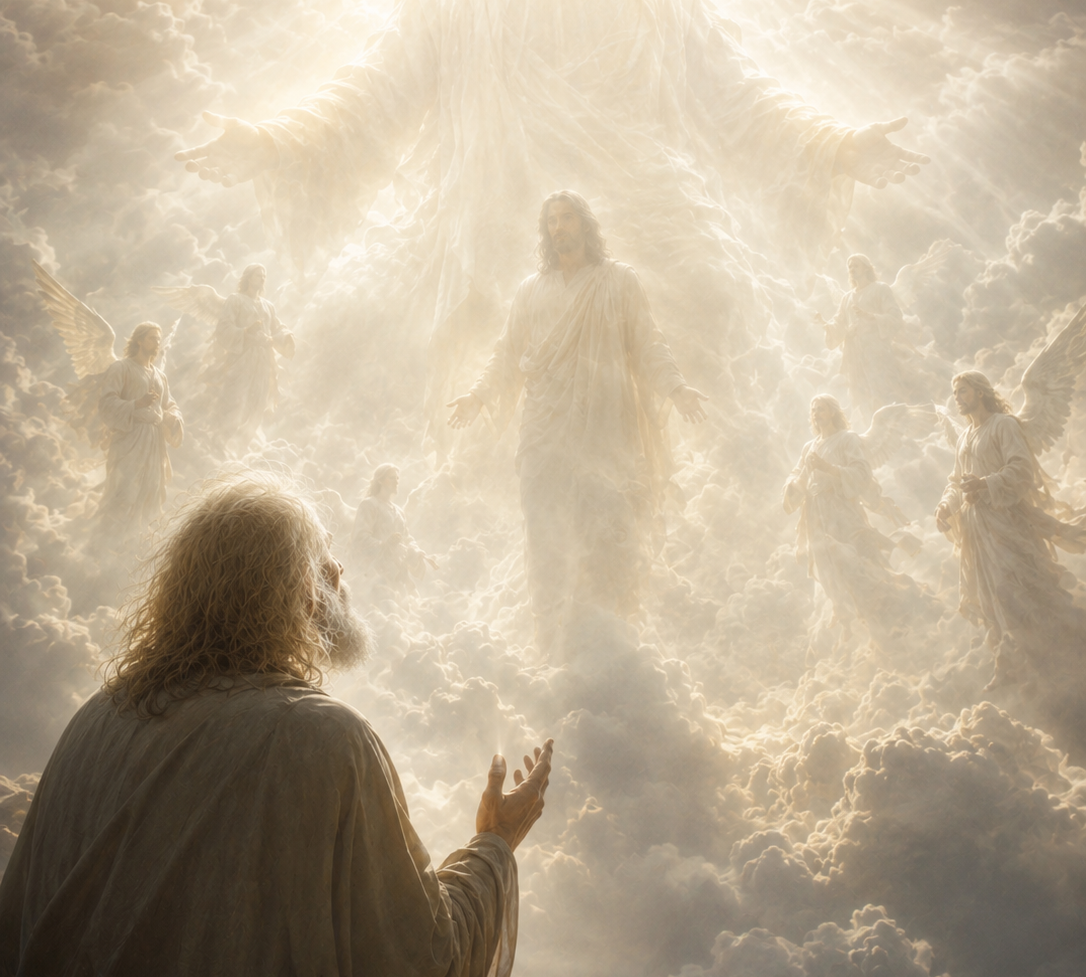
Shout out to ChatGPT for generating this image that imagines the Patriarch Enoch encountering the Chosen One (aka Messiah) in Heaven with the Lord of Spirits (aka God) in the background, as described in the Book of Similitudes in the First Book of Enoch.
In His Own Words: Evaluating Christian Claims about Jesus from the Gospel of John through the Context of 1st Century Jewish Messianism
By Daniel Silverman
Written on April 1, 2026
Introduction
“Who was Jesus of Nazareth?” This is a question that many traditionalist Christians of today would hope that American society seriously consider in an era of declining religiosity (The State of Theology, no date) and increasing plurality and heterogeneity among American Christians (Is Jesus Divine? 30% of “Evangelicals” Say No., 2020). The question, however, is a rhetorical one, in that the traditionalists who ask it believe that the correct answer is a variation of the statement that “Jesus Christ is God.” For many traditionalists, such as Professor Stephen J. Wellum, this question is essential restoring a sense of Christian religiosity in America (Hearne, 2021). In contrast, an array of scholars, including Professors Bart Ehrman (F et al., 2014) and Dale Allision (Bi, no date), have argued that Jesus never intended to be called God and that he should best be understood as an apocalyptic preacher.
The disagreements reveal more about the state of modern Christianity than about the historical reality of Jesus’ cultural and political environment, namely because this debate fails to account for the different ways Jews in the 1st century AD/CE believed in messianism.
This paper seeks to enrich the ongoing discussions about Jesus’ divinity by introducing a third option for consideration. This third option will draw upon modern scholarship about and texts related to 1st century messianism to present the possibility that a portion of Jesus’ followers saw him neither as equal to God nor as a mundane, human figure. Rather, some, if not all, of the members of the nascent Christian movement in the 1st century conceptualized Jesus as a heavenly messiah that occupied a secondary position of authority after YHWH, the Supreme God. This third option would break the otherwise binary answer choice and submit an alternative conclusion that both traditionalist Christians and their opponents would likely find incompatible with their beliefs.
The first section of this paper will overview the diversity, as opposed to uniformity, of beliefs about messianism among 1st century Jews. The following section will examine the First Book of Enoch as an example that illustrates in what ways 1st century Jews conceived of a heavenly messiah. The last section will speculate how the underlying cultural notion(s) of a heavenly messiah likely shaped the most explicit Christological claim about Jesus in the Gospel of John.
Section 1: Messianism Among 1st Century Jews
It may be an academic cliché to say that there were diverse messianisms in the Second Temple Era. In the introduction to “Judaisms And Their Messiahs At The Turn Of The Christian Era,” Jacob Neusner, William Green, and Ernest Frerichs write that, “Diverse “Judaisms” flourished, each with its particular way of life, world view, and definition of the social entity... Because there was no single, unitary Judaism, there also was no one “Messiah-idea” or “Messianic doctrine” (Neusner, Green and Frerichs, 1987). Nonetheless, in order to proceed with a deeper conversation about heavenly messianism and the Gospel of John, some space must be reserved to first exemplify the multiplicity of messianic belief systems that existed among 1st century Jews.
To begin, we should understand that expectations of a messianic savior were not universal during the Second Temple Era, and therefore it is unlikely that all those who encountered Jesus and/or his followers would have been immediately familiar with a singular messianic concept. The scholarly opinion from the 19th and early 20th centuries, put forth by figures such as Emil Schürer and George Foot Moore, that a uniform messianic ideology existed in the 1st century depends on analyses primarily from 4 Ezra and 2 Baruch, which proves problematic given that the Dead Sea Scrolls had not been discovered yet and that the other two Second Temple Era texts available prior to 1947 that explicitly use the word “messiah” – the Psalms of Solomon and 1 Enoch – do not present the same vision of a royal and Davidic messiah (Collins, 2010, p. 4). In his essay “Messiah in Judaism,” William Green notes how relatively scarce the term “messiah” appears in the wider corpus of Second Temple Era literature, and he goes as far as to say that “One may wonder, in other words, how so much has come to be written about an allegedly Jewish conception in which so many ancient Jewish texts manifest such little interest” (Neusner, Green and Frerichs, 1987, p. 4). In fact, Green goes on to say that the “primacy of “the messiah” as a subject of academic study derives not from ancient Jewish preoccupation, but from early Christian word-choice, theology, and apologetics” (Neusner, Green and Frerichs, 1987, p. 4). Even E.P. Sanders, a celebrated American Protestant theologian, even admitted that “the expectation of a messiah was not the rule” (Collins, 2010, p. 5).
Although Green believes that notions of “syncretic” or “uniform” Jewish traditions about the messiah should be abandoned, he does posit that scholarship about messianism should be refined to appreciate heterogeneity rather than simply dismissing the historicity of the notion (Neusner, Green and Frerichs, 1987, p. 10). Burton Mack goes in farther by declaring the subject should adopt an “analytical approach… in which a given text relates to its contexts as systems of meaning already in place” (Neusner, Green and Frerichs, 1987, p. 15). In particular, Mack encourages us to treat messianism through the lens of social anthropology, so that the “notion of the messiah actually is a compositive characterization won from the set of texts traditionally designated as messianic” (Neusner, Green and Frerichs, 1987, p. 17). His call for an interdisciplinary approach to messianism that includes social anthropology is crucial, as it allows us to consider that Jesus’ followers did not immediately assume an understanding of his eschatological role upon interacting with him. Rather, Jesus’ followers may have constructed either a singular or multiple understandings about him by drawing from different messianic ideas over time, including after his execution.
An additional problem for us to consider is the very the term “messiah” itself. As John Collins describes in his book “The Specter and the Star,” the word “messiah” itself “means simply “anointed” and does not necessarily refer to an eschatological figure at all” (Collins, 2010, p. 16). Furthermore, “While it refers to a royal figure some thirty times in the Hebrew Bible, it can also refer to other figures, most notably the anointed High Priest” (Collins, 2010, p. 16). Despite the limits of textual examples of the specific term “messiah,” Collins recognizes the word embodies a wider literary trope of an eschatological figure who serves a critical role in the future hope of the Israel/the world (Collins, 2010, p. 17). Given ““messiah,” even as an eschatological term, can refer to different kinds of figures,” Collins provides his readers with four typological categories of messianism constructed from patterns found in eschatological-related texts (regardless of whether they use the specific term “messiah”): king, priest, prophet, and heavenly messiah (Collins, 2010, p. 18). It is the last category, the “heavenly messiah”, which will be focus of this paper.
It is critical to note that the figure of the heavenly messiah was distinct from YHWH – the Supreme God of Heaven - and did not necessitate individual worship. For example, Collins identifies that, “In Psalm 45 the king is addressed as אלהים, “God”… While the king was not to be confused with the Almighty, he was exalted above the common rank of humanity” (Collins, 2010, p. 26). This 1st century typology of the heavenly messiah, contrary to the beliefs that modern Christian traditionalists have about Jesus, portrays a figure with divinity and greater power than that of ordinary human beings, but not deserving of the same praise and respect as YHWH.
It must be highlighted that analyzing 1st century messianic beliefs should not be limited to canonical tradition. As Collins notes, “Ancient Judaism did not have a creed that defined orthodoxy, in the manner of later Christianity” (Collins, 2010, p. 21). The fact that the Epistle of Jude (1:14-15) quotes from 1 Enoch (1:9) demonstrates that Jesus’ followers were aware of and/or familiar with and willing to borrow ideas from texts that eventually failed to enter the Biblical canon. Not all texts may have been widely distributed or read, but the variety of scriptural traditions allows us to broadly imagine the diversity in which Jesus’ followers may understood his claims to messianic leadership. As Collins succinctly puts it, “The Dead Sea Scrolls provide ample evidence that the canon had not been closed around the turn of the era. Books such as Enoch and Jubilees are preserved in multiple copies and were evidently authoritative” (Collins, 2010, p. 22).
This is especially important for the anthropological analysis of 1st century Jews, as, according to Collins, “in Judaism at the turn of the era the available ideologies were predominantly shaped by scriptural traditions” (Collins, 2010, p. 51). Thus, the discoveries at Khirbet Qumran alone give us reason to suspect that the so-called “apocryphal texts” may have had varying degrees of influence over 1st century Jews. With that note, we shall now proceed to discuss 1 Enoch.
Section 2: 1 Enoch
The value of 1 Enoch for this paper lies with the eschatological figure introduced in the section of the text known as the “Similitudes of Enoch” (known alternatively as the Book of Parables), which covers chapters 37 – 71. In his essay “Salvation without and with a Messiah,” George W.E. Nickelsburg duly notes how the eschatological figure introduced in the Similitudes (hereafter referred to as “the Enochic Messiah”) is only twice referred to as the “Anointed One” (“messiah”), and instead is more commonly associated with the titles “Son of Man” and “Chosen One.”[1] However, as Nickelsburg also writes that the four names given to the Enochic Messiah – “the Chosen/Elect One”, “the Righteous One”, “the Son of Man”, and “the Anointed One” (messiah) – connect him to characters from Biblical texts, such as the enigmatic “son of man” figure Book of Daniel and the Servant of the Lord from the Deutero-Isaianic texts from the Book of Isaiah (Neusner, Green and Frerichs, 1987, p. 58). Moreover, multiple titles allow the author of 1 Enoch to elevate the Enochic Messiah from a mere human descendant of David to an angelic being conceived in Heaven. In Nickelsburg’s words, “by conflating the messianic tradition with the other two, the author depicts the Messiah not as the human son of David, but as a transcendent figure” (Neusner, Green and Frerichs, 1987, p. 65).
We should briefly note that the Similitudes differ from the rest of 1 Enoch in that it centers heavily on soteriology and theological judgement, the latter of which is administered by the messianic figure. (Neusner, Green and Frerichs, 1987, p. 56) According to Nickelsburg, the theme of divine judgement and the role of the Enochic Messiah represents the “latest stratum” in the composition of 1 Enoch, because “a tradent of Enochic tradition or a group of such sages have drawn materials from outside this tradition and created a composite figure to serve the judicial and salvific functions that the earlier Enochic traditions ascribed to men, angels, and God” (Neusner, Green and Frerichs, 1987, p. 56). It should also be noted that the text fragments of 1 Enoch found among the Dead Sea Scrolls at Qumran do not include portions of the Similitudes (Enoch in the Old Testament and Beyond | Religious Studies Center, no date), which gives credence to Nickelsburg’s assertion.
In fact, without the preservation efforts of the Ethiopian Oriental Church, the full text of 1 Enoch it would have been lost (1 Enoch, no date). Nonetheless, the theological and literary themes of the Similitudes suggest that it was most likely composed during the last century of the Second Temple Era, if not soon after the destruction of the Second Temple in 70 AD/CE (Enoch in the Old Testament and Beyond | Religious Studies Center, no date). According to James Charlesworth, “chapters 37-71 could have been added in the first century B.C. or first century A.D” (1 Enoch, no date). Nickelsburg himself notes that the Enochic Messiah was a prototype figure that “continued to appear in Jewish works written shortly after the fall of Jerusalem in 70 C.E” (Neusner, Green and Frerichs, 1987, p. 65). Thus, the character of the Enochic Messiah would have been developed in parallel to the budding early Christian movement even if it was not composed prior to Jesus’ crucifixion.
The Enochic Messiah is unique both because of his predestined mission and for the nature of his origins. As Nickelsburg notes, “he is not kind of Messiah described in texts that await a Davidic king or a Levitic priest” (Neusner, Green and Frerichs, 1987, p. 56). David Flusser puts it beautiful when he writes that, “The Son of Man has a superhuman, heavenly sublimity. He is the cosmic judge at the end of time. Sitting upon the throne of God… he will cosign the just to blessedness and the wicked to the pit of hell” (Flusser and Notley, 1998, pp. 129–130).
Physically, the text of the Similitudes characterizes the Enochic Messiah as a hybrid of both human and angel. Consider the following description:
“…whose countenance resembled that of man;
His countenance was full of grace, like that of one of the holy angels” (1 Enoch 46:1) (Book of Enoch, no date)
This description clearly combines both human and angelic attributes to the Enochic Messiah, thus portraying him as some transcendent figure beyond human ability.
Moreover, the author of the Similitudes frames the internal essence of the Enochic Messiah as innately divine and linked to God. Chapter 46 of the 1 Enoch reads:
“This is the Son of man, to whom righteousness belongs;
with whom righteousness has dwelt;
and who will reveal all the treasures of that which is concealed: for the Lord of spirits has chosen him;
and his portion has surpassed all before the Lord of spirits in everlasting uprightness.” (1 Enoch 46:2)(Book of Enoch, no date)
Additionally, consider the following verses from chapter 48 of 1 Enoch:
“Therefore the Elect and the Concealed One existed in his presence, before the world was created, and for ever.
In his presence he existed, and has revealed to the saints and to the righteous the wisdom of the Lord of spirits;
for he has preserved the lot of the righteous, because they have hated and rejected this world of iniquity, and have detested all its works and ways, in the name of the Lord of spirits.” (1 Enoch 48:5-6)(Book of Enoch, no date)
These verses, among others, demonstrate how the author of the Similitudes conceived an expected messianic savior whose destiny is not only mandated by God, but whose very origin is connected to YHWH like no other being. As Nickelsburg aptly notes, “As the one whom the Lord of Spirits has chosen… he is the highest functionary in the heavenly court – thus surpassing in rank even the four archangels, Michael, Raphael, Gabriel, and Phanuel.”(Neusner, Green and Frerichs, 1987, p. 59)
Though the Enochic Messiah is the most exalted of God’s creations, but he still occupies a secondary and subservient position to YHWH, as can be observed from the following verses:
“He shall be the hope of those whose hearts are troubled. All, who dwell on earth, shall fall down and worship before him; shall bless and glorify him, and sing praises to the name of the Lord of spirits.” (1 Enoch 48:4)(Book of Enoch, no date)
“In his presence shall they fall, and not be raised up again; nor shall there be any one to take them out of his hands, and to lift them up: for they have denied the Lord of spirits, and his Messiah. The name of the Lord of spirits shall be blessed.” (1 Enoch 48:11).
Even though the author of 1 Enoch describes the Enochic Messiah as possessing divine authority, ultimately the Lord of Spirits – YHWH – remains the object of praise. Even verse 4 of chapter 48, which describes how the righteous of humanity shall bless and worship the Enochic Messiah, it is God, not the Enochic Messiah, whose name receives praises. It is the Lord of Spirits whose name shall be blessed, whereas the true name of the Enochic Messiah is never even written. Verse 3 of chapter 45 notes,
“In that day shall the Elect One sit upon a throne of glory; and shall choose their conditions and countless habitations, while their spirits within them shall be strengthened, when they behold my Elect One, for those who have fled for protection to my holy and glorious name.” (1 Enoch 45:3)(Book of Enoch, no date)
Even when the Enochic Messiah assumes authority upon a throne in Heaven, the power of God will prove supreme in that the invocation of his name will provide salvation for the righteous. To use Nickelsburg’s wording, “The central figure of the Parables is God’s heavenly vice-regent.”(Neusner, Green and Frerichs, 1987, p. 63) A regent may exercise regal authority, but a regent does not command subservience in the manner of a king.
The Enochic Messiah provides us with an example of a developed messianic ideal where the Messiah is conceptualized as first and foremost a heavenly agent of God whose divine origins transcends mere human existence. The dating of the Similitudes may be contestable, but it most likely became widespread, at the latest, around the same time that Jesus’ followers began developing their community. The Epistle of Jude shows us that at least some of the early Christians were familiar with Enochic literature, and therefore it certainly remains plausible that some in the emerging Christian movement came across the Similitudes. Regardless, the Similitudes best aid us on this topic by illuminating a firm example of how 1st century Jews conceived the notion of a heavenly messiah.
The example of the Enochic Messiah demonstrates that the broader categorical concept of a heavenly messiah that transcended human limitations and origins was a messianic typology that developed, at the very least, concurrently with the early formation of the Christian community.
Section 3: Christology in the Gospel of John
This section will focus on the most explicit statement that the author of the Gospel of John reports that Jesus made about his divinity, which chapter 8 delivers as such:
““Very truly I tell you,” Jesus answered, “before Abraham was born, I am!”” (NIV, John 8:58)
We will focus on the Christology of the Gospel of John, not least because it is this quote that Bart Ehrman (F et al., 2014) and Dale Allision (Bi, no date) describe as the most relied-upon text that modern Christian traditionalists use to claim that Jesus is God. Moreover, John 8:58 is unique in that in claims to represent an explicit statement that Jesus made about himself, whereas other Christological verses, such as John 1:1 (“the Word was with God, and the Word was God”), are made by the narrator. Other quotes about Jesus’ connection with God the Father/YHWH that the Johannine text presents, such as John 14:9 (“If you've seen me, you've seen the Father.”), are not as immediately obvious in comparison to John 8:58 as statements about Godhood.
John 8:58, however, stands out in that the specific phrase “I am” seemingly refers to the utterance of “ehyeh” (אֶהְיֶה) that God makes to Moses:
“God said to Moses, “I am who I am.[c] This is what you are to say to the Israelites: ‘I am has sent me to you.’” (NIV, Exodus 3:14)
The fact that chapter 8 of the Gospel of John concludes with a mob of Jesus’ countrymen attempting to stone him at the temple grounds in Jerusalem demonstrates that learned Jews of the Second Temple Era linked his statement with Exodus 3:14. Yet while modern Christian traditionalists would have us believe that John 8:58 is an obvious claim about Godhood, we should pause to consider this statement in light of our understandings of the heavenly messiah typology.
To reiterate, the notion of a heavenly messiah among 1st century Jews was that of some kind of transcendent figure who possessed divine power under the authorization of God, but himself was not equal or identical with YHWH. That said, a third figure in addition to Moses and God is mentioned in the burning bush incident of chapter 3 of the Book of Exodus.
“Now Moses was tending the flock of Jethro his father-in-law, the priest of Midian, and he led the flock to the far side of the wilderness and came to Horeb, the mountain of God. There the angel of the Lord appeared to him in flames of fire from within a bush.” (NIV Exodus 3:1-2)
Within the context of angels as messengers of God (given that “מַלְאָךְ” literally denotes “messenger”), we can understand that the text implies God as speaking to Moses through the angel. Had it been God, rather than an angel, physically present at Horeb, it stands to reason that this enigmatic “angel of the Lord” would not need to have been mentioned.
Moreover, the method in which Moses approaches the angel should catch our attention. The text describes God instructing Moses to:
““Take off your sandals, for the place where you are standing is holy ground.”” (NIV Exodus 3:5).
Again, God is not physically present with Moses in this narrative, but rather speaking to him through an angel. Hence, the story depicts Moses as taking off his sandals before an angel. This is notable, as the only other instance of a character taking off footwear in respect to some aspect of divinity is in the Book of Joshua.
“The commander of the Lord’s army replied, “Take off your sandals, for the place where you are standing is holy.” And Joshua did so.” (NIV Joshua 5:15)
Here, Joshua does so not on behalf of instructions from God, but from this mysterious “commander,” whose exact identity is left unknown. We as readers can presume that the commander may be some kind of angel, but the only assured fact we have is that the figure occupies a position of high relevance under God’s authority. When we consider how the Enochic Messiah is described as having authority that surpasses even the archangels, we can begin to appreciate the possibility that the statement Jesus makes in John 8:58 is not about Godhood, but about his claims as a heavenly messiah similar to the angelic figure in Joshua.
The Pharisees described in chapter 8 of the Gospel of John would presumably been familiar with the texts of both Exodus and Joshua, if not the wider literature about heavenly messiahs of the time. This may explain why the author of the Johannine narrative does not bother to explain why the mob questioning Jesus proceeded to attack their fellow Jew after his “I am” declaration. Had the Pharisee-led crowd understood the statement of “I am” to represent a self-statement of Godhood, it stands to reason that they would have been left confused, as no indication in the texts of Exodus or Joshua explicitly affirms a human being as equal and identical with YHWH. However, these texts, as demonstrated earlier, do link the “I am” statement to either a singular or multiple angelic entities.
Thus, this scene described by the Gospel of John may actually represent a narrative incident in which the Pharisees – with their knowledge of the texts of Exodus and Joshua and, perhaps, the broader notion of heavenly messianism – violently reacted to Jesus not because of any claims about Godhood, but rather because he dared attest his identity as a transcendent messianic figure. This paper submits that it is more plausible that the author of the Gospel of John intended the “I am” statement in chapter 8 to be understood as a claim of heavenly messianism as opposed to Godhood.
Conclusion
In the conclusion to chapter 9 of his book “Jesus,” David Flusser writes, “The one like a man who sits upon the throne of God’s glory, the sublime eschatological judge, is the highest conception of the Redeemer ever developed by ancient Judaism… Could Jesus of Nazareth have understood himself thus?” (Flusser and Notley, 1998, p. 132). It is beyond the ability of anyone, this writer included, to prove beyond any reasonable doubt what thoughts or intentions the historical Jesus may have had. It is possible, however, to demonstrate what the author of the Gospel of John may have intended for the literary Jesus.
By discussing the diversity of messianic ideals present in 1st century Jewish life and two examples of heavenly messiahs found in 1 Enoch and the Apocalypse of Abraham, this paper hopes to have established a decent argument that the author of the Gospel of John relied upon an understanding of heavenly messianism when writing the Christological “I am” statement in chapter 8.
There are further topics and questions that this paper did not explore in order to respect the limitations for the lengths of this assignment. Further expansions of this paper would ideally include conversations about the contributions that the Dead Sea Scrolls and other 1st century Jewish texts, such as the Apocalypse of Abraham, have had for modern understandings of messianism, especially regarding the topic of the ascendancy of humans into angelic beings and suffering messiahs. Lastly, this paper focused exclusively on the Gospel of John, but a wider and more holistic discussion of Jesus and his claims to messianism would invariably have to include the Synoptic Gospels. This said, the main objective of this paper – namely to analyze the claim that modern Christian traditionalists make about Jesus’ Godhood by interpreting John 8:58 through the contexts of 1st century heavenly messianism – has arguably been met under the concise limitations for this assignment.
Before ending, it must be reiterated that the thrust of this paper has been focused on the portrayal of Jesus from the text of the Gospel of John. Whether or not the literary figure of Jesus from the Johannine text should be synonymous with the historical Jesus of reality remains a question well beyond the ability of anyone, this writer included, to answer to universal satisfaction. Likewise, whether or not the incident depicted in chapter 8 actually occurred remains up to personal interpretation. The only path for any reputable academic investigation into the debate over Jesus’ Godhood lies with textual and literary analyses of the Christological claims in the New Testament gospels. Hopefully, this paper has properly demonstrated that the answer choice for such a debate is not binary, but, at the very least, trinary in nature.
One might dare to ask what inspired some, if not all, of Jesus’ followers in the beginning formation of the early Christian community to believe Jesus was a heavenly messiah, as demonstrated by the composition and circulation of the Gospel of John. This is not just the topic for another paper, but, perhaps, an issue for a new discussion altogether.
Bibliography (Chicago Manuel of Style 18th Edition, author-date)
1 Enoch (no date). Available at: https://www.earlyjewishwritings.com/1enoch.html (Accessed: April 1, 2026).
Bi, J. (no date) Transcript of Interview with Dale Allison on New Testament Scholarship. Available at: https://www.johnathanbi.com/p/transcript-of-interview-with-dale-allison-on-new-testament?utm_medium=email (Accessed: March 2, 2026).
Book of Enoch (no date). Available at: http://www.johnpratt.com/items/docs/enoch.html (Accessed: April 1, 2026).
Collins, J.J. (2010) The Scepter and the Star: Messianism in Light of the Dead Sea Scrolls. Grand Rapids, Mich: Wm. B. Eerdmans Publishing Co.
Enoch in the Old Testament and Beyond | Religious Studies Center (no date). Available at: https://rsc.byu.edu/creation-sinai/enoch-old-testament-beyond (Accessed: April 1, 2026).
F et al. (2014) “If Jesus Never Called Himself God, How Did He Become One?,” NPR, 7 April. Available at: https://www.npr.org/2014/04/07/300246095/if-jesus-never-called-himself-god-how-did-he-become-one (Accessed: March 2, 2026).
Flusser, D. and Notley, R.S. (1998) Jesus. Jerusalem: Magnes Pr.
Hearne, T. (2021) “Dear Church: Jesus Is God, So Please Don’t Call Him the First and Greatest Created Being,” Southern Equip, 23 February. Available at: https://equip.sbts.edu/article/dear-church-jesus-is-god-so-please-dont-call-him-the-first-and-greatest-created-being/ (Accessed: March 2, 2026).
Is Jesus Divine? 30% of “Evangelicals” Say No. (2020) Ligonier Ministries. Available at: https://www.ligonier.org/posts/jesus-divine-30-evangelicals-say-no (Accessed: March 2, 2026).
Neusner, J., Green, W.S. and Frerichs, E.S. (eds.) (1987) Judaisms and their Messiahs at the Turn of the Christian Era. Cambridge Cambridgeshire ; New York: Cambridge University Press.
The State of Theology (no date) The State of Theology. Available at: https://thestateoftheology.com (Accessed: March 2, 2026).