
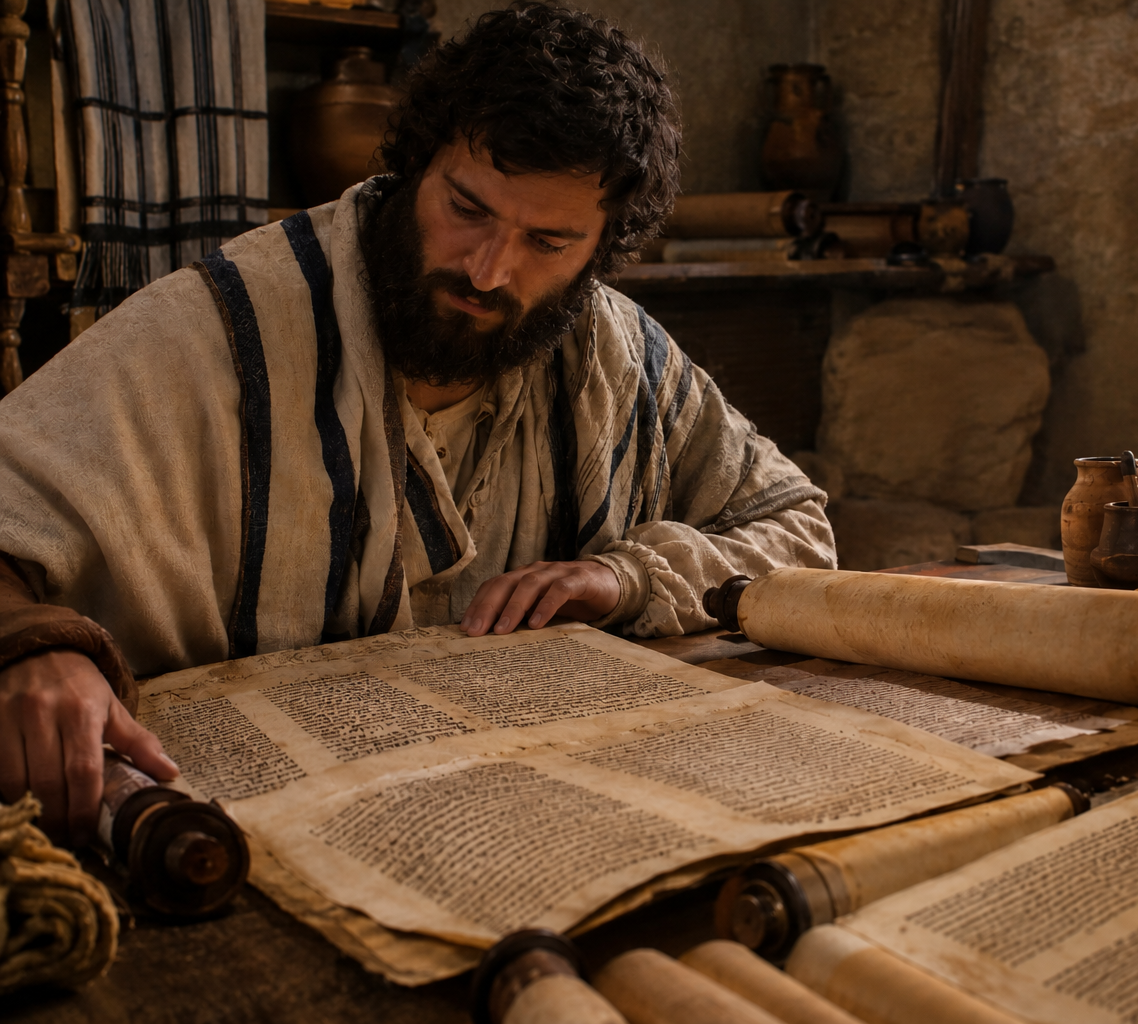
An image generated by ChatGPT that portrays a man in Ancient Judea during the Second Temple Period reading with texts from the Similitudes of 1 Enoch, the Apocalypse of Abraham, 4 Ezra, and the Self-Glorification Hymn.
A Messiah of His Time: Considering Jesus of Nazareth through Jewish Angelic Messianism
By Daniel Silverman
Completed writing on September 25, 2026
Preface
The following blog post is an essay that I submitted as one of two seminar papers in order to complete the graduation requirements for the Bible and Ancient Near East M.A. program offered by the Rothberg International School of the Hebrew University of Jerusalem. This essay itself is an extension of an earlier essay I wrote titled "In His Own Words: Evaluating Christian Claims about Jesus from the Gospel of John through the Context of 1st Century Jewish Messianism", which can be read here.
The essay is quite long, so as a TL;DR, here is a short summary that encapsulates the general gist of what I wrote:
This paper draws on existing scholarly research and theories about Second Temple Period messianism to reconsider the traditionalist Christian assumptions about Jewish messianic expectations of the time. It particularly focuses on the the notion of what can be referred to as "angelic messianism" to demonstrate that messianic concepts included both transcendent, angel-like savior figures as well as human kings descended from David. Contemporary texts from the Second Temple Period demonstrate that two strands of angelic messianism - heavenly messiahs who come down to Earth and humans who rise into Heaven as exalted angelic beings - can be identified. Specifically, this paper overviews 4 Ezra, the Apocalypse of Abraham, and the Similitudes of 1 Enoch, the Qumran Self-Glorification Hymn, 3 Enoch, and the Melchizedek text 11Q13. Importantly, many messianic texts of the era stress that the expected messiah holds great divine authority while remaining below and separate from God (referred to as "YHWH" in the essay). The paper ends with considering how Jesus’ “before Abraham was, I am” statement in 8:58 of the Gospel of John better reads as a claim of tying Jesus to the angel of the Lord in the burning bush of Exodus 3 than as a Trinitarian declaration of Jesus' co-equality with YHWH.
The essay I wrote does not intend to be polemic against any denomination of Christianity, but rather hopes to raise intrigue about a topic that many people hold as important to this day. For those who do read this entire text, I hope it proves to be entertaining if not thought-provoking.
- Daniel Silverman,
October 29, 2026
Introduction
In an era of declining religiosity and increasing religious heterogeneity among American Christians (State Theol., n.d.), many traditionalist Christians believe in reinforcing a belief in the godhood of Jesus of Nazareth as a means of reviving Christian faith (Ligonier Ministries 2020). Some Christian traditionalists, such as Stephen J. Wellum, have argued that hesitations about Jesus’ divinity threaten the very foundations of Christianity in America (Hearne 2021).
Some scholars, such as Bart Ehrman (Gross 2014) and Dale Allison (Bi 2026), have argued that Jesus should best be understood as an apocalyptic preacher who never intended to be considered co-equal and co-eternal with YHWH. Allison, for example, has contended that the deification of Jesus only began after his crucifixion (Bi 2026).
The modern disagreement over whether Jesus was the incarnation of a segment of the Holy Trinity or a mortal man reveals more about the state of modern Christianity than about the historical reality of Jesus’ cultural and political environment. In particular, contemporary debates in America about Jesus, particularly when initiated by Christian traditionalists, often seem to assume that a singular conception of messianism pervaded Judea and the wider Jewish Diaspora during the Second Temple Period.
While conceptions that the coming messiah would be a mortal man descended from David certainly existed during the Second Temple Period, contemporary literature reveals that imaginations of a heavenly messiah that transcended the limitations of regular humans also captured popular belief at the time. In an essay titled “Messianism in the Maccabean Period”, John Collins wrote,
The development of interest in angelic savior figures had enormous importance for later tradition. It is an important factor in the Christian identification of Jesus as the “Son of Man” and in early descriptions of the glorified Christ. Within Judaism we find the development of such figures in the Similitudes of Enoch, in Jaoel of Apoc Abraham, and ultimately in the Metatron of 3 Enoch, who is even called the “lesser YHWH” … We should note that the transcendent angelic figure coexists with the expectation of human messiahs in the Qumran scrolls, even in individual documents such as the Community Rule (1QS) and the Damascus Document (CD). Whereas the two kinds of messianism (transcendent and earthly) are different in origin and function, they are not mutually exclusive. (Collins 1987, 102–3)
This paper will draw upon the insight laid above by Collins and investigate the development and nature of Jewish angelic messianism through literary examples dating from and after the Second Temple Period. However, this paper will distinguish itself from the sources and scholarly material that it draws upon by approaching the topic of angelic messianism through two distinct angles: angelic messiahs who descend to Earth and humans who ascend to Heaven as angelic beings. By recognizing that popular conceptions of messianism and angels in ancient Jewish circles did not follow a singular archetype, this paper will position itself to better approach how the Christological claims present in the Gospel of John may have been intended to be received by readers upon its initial circulation. As many evangelists and Christian apologists rely on passages from the Gospel of John to argue for High Christological claims about Jesus, this paper will focus on utilizing examples of messianic and angelic Jewish literature from the Second Temple Period and antiquity to consider how the members of the nascent Christian movement in the 1st century AD/CE conceptualized Jesus as a heavenly messiah that occupied a secondary, as opposed to equal, position of authority after YHWH.
The arguments for this paper will be divided into four sections. The first section of this paper will summarize some of the dominant positions among scholars about the diversity of messianic beliefs that existed among Jewish groups in the Second Temple Period. The second section will examine examples of angelic messiahs as portrayed in 4 Ezra, the Apocalypse of Abraham, and 1 Enoch. The third section will overview examples of ancient Jewish literature where mortal human beings ascended into Heaven as transcendent angelic beings. The last section will synthesize observations from the preceding sections to consider how beliefs in angelic messiahs and humans who transcended into Heaven as angelic beings can shape our understandings of the intentionality of Jesus’ claim in chapter 8 of the Gospel of John, which may be the most explicit Christological claim about Jesus’ divinity in the four New Testament gospels.
The ability to provide a resounding resolution to the debate on whether Jesus should be considered co-equal and co-eternal with a supreme Creator is neither within the power nor intention of this paper. Rather, the following discussion hopes to foster a greater appreciation of messianic diversity that existed in Ancient Judea and the Jewish Diaspora of antiquity, and in doing so perhaps sharpen our skepticism to any claim by modern religious apologists about the culture and religious environment of the Second Temple Period.
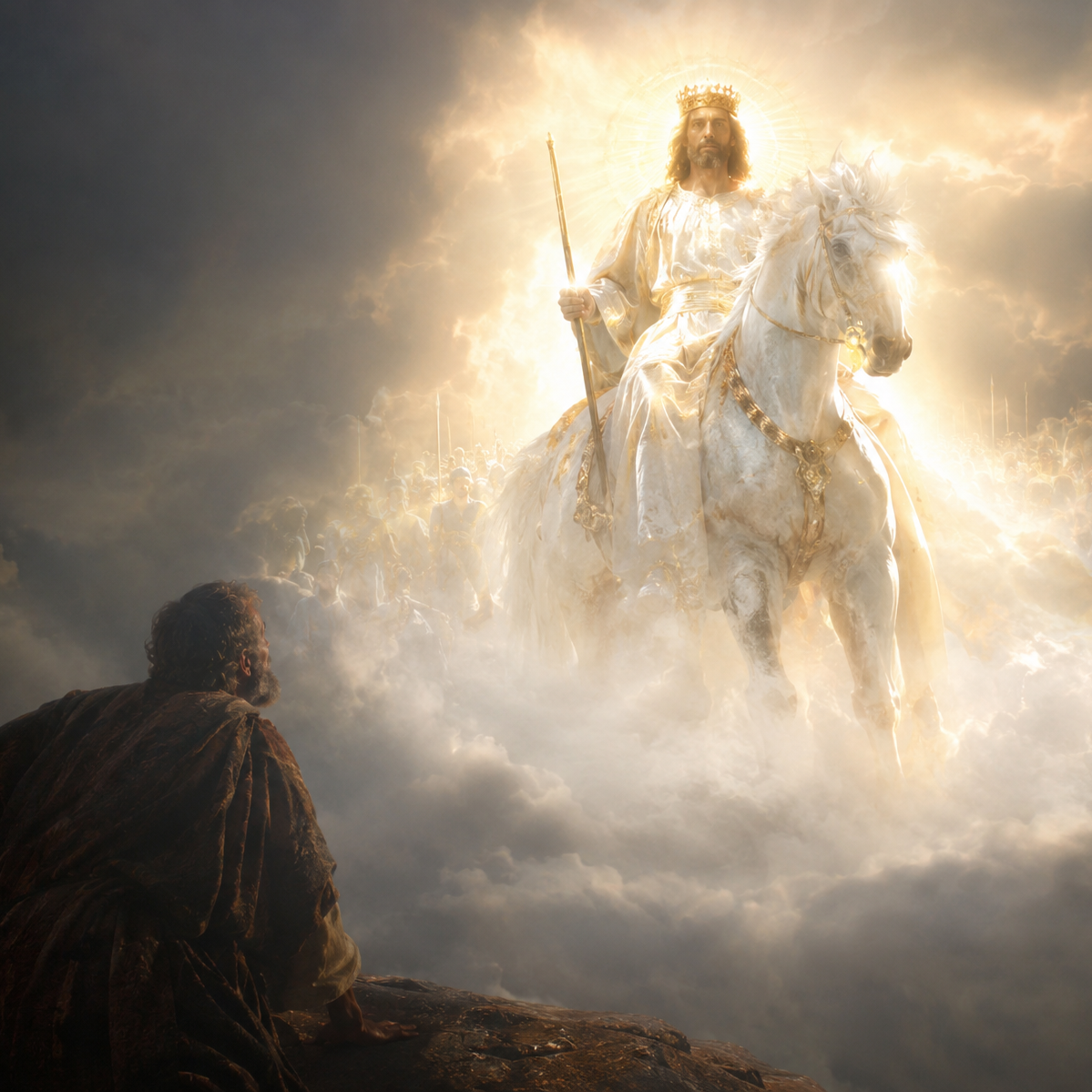
An image generated by ChatGPT that imagines the Messiah as depicted in 4 Ezra.
Section 1: Messianism in the Second Temple Period
To write that there were diverse messianisms in the Second Temple Era approaches something of an academic cliché nowadays. In the back cover summary to Judaisms and Their Messiahs at the Turn of the Christian Era, Jacob Neusner, William Green, and Ernest Frerichs write that, “Diverse “Judaisms” flourished, each with its particular way of life, world view, and definition of the social entity [...] Because there was no single, unitary Judaism, there also was no one “Messiah-idea” or “Messianic doctrine.” (Neusner et al. 1987). Nonetheless, some space must be reserved to first exemplify the multiplicity of messianic beliefs that existed among Jewish groups during the Second Temple Period before we can engage in a meaningful conversation about heavenly messiahs, angelic beings, and the Gospel of John.
First, we should understand that expectations of a messianic savior were not universal during the Second Temple Period, and therefore it is unlikely that all those who encountered Jesus or his followers would have necessarily shared a common messianic belief. Prior to the discovery of the Dead Sea Scrolls, scholars in the late 19th and early 20th centuries, such as Emil Schürer and George Foot Moore, argued that a uniform messianic ideology existed in the wider Jewish world of the 1st century (Collins 2010, 4). However, this argument would later be challenged by the Dead Sea Scrolls, and by the recognition that the two other Second Temple Period texts available prior to 1947 that explicitly use the word “messiah” – the Psalms of Solomon and 1 Enoch – do not present the same vision of a royal and Davidic messiah (Collins 2010, 4). In his essay “Messiah in Judaism: Rethinking the Question,” William Green notes how rarely the term “messiah” appears in the wider corpus of Second Temple Era literature (Green 1987, 4). In his opinion,
One may wonder, in other words, how so much has come to be written about an allegedly Jewish conception in which so many ancient Jewish texts manifest such little interest … [The] primacy of “the messiah” as a subject of academic study derives not from ancient Jewish preoccupation, but from early Christian word-choice, theology, and apologetics. (Green 1987, 4)
Similarly, Collins expresses how messianism likely did not occupy an ideological prerogative among the political and social elite of the wider Jewish world of the Second Temple Period:
There are some traces of messianism in the Maccabean period. It is evident, however, that messianism was neither widespread nor prominent in this period and there was no one “orthodox” notion of “the Messiah.” The traditions on which Davidic messianism was based were preserved, but these in themselves did not ensure any lively expectation. The presence or absence of messianism was primarily determined by the political attitudes and circumstances of the different groups within Judaism. Those who placed their hopes in the institutions and leaders of their day, whether the High Priests, the Ptolemies, or the Maccabees, had little interest in messianism. Apocalyptic groups developed the idea of a transcendent savior figure, either as an alternative or as a complement to earthly messianism. Only with the rise of the Qumran community do we find a group with a strong and developed interest in messianism, and then again in the first century B.C.E. in the Psalms of Solomon.(Collins 1987, 106)
Even E.P. Sanders, a historian of ancient Judaism and a New Testament scholar, admitted that “the expectation of a messiah was not the rule” (Collins 2010, 5). In sum, at the time of Jesus’ ministry in the Galilee and Judea, it would be erroneous to assume that even those who came to believe in Jesus as the awaited messiah all shared a unified concept of who this promised Messiah was, what he was meant to do, and the nature of his divine background, if he had any at all to begin with.
Although Green believes that notions of “syncretic” or “uniform” Jewish traditions about the messiah should be abandoned, he does posit that scholarship about messianism should be refined to appreciate heterogeneity rather than simply dismissing the historicity of the notion (Green 1987, 10). Burton Mack goes further by declaring the subject should adopt an “analytical approach… in which a given text relates to its contexts as systems of meaning already in place.” (Mack 1987, 15) Moreover, Mack encourages us to treat messianism through the lens of social anthropology, so that the “notion of the messiah actually is a compositive characterization won from the set of texts traditionally designated as messianic.” (Mack 1987, 17) His call for an interdisciplinary approach to messianism that includes social anthropology is crucial, as it allows us to consider that Jesus’ followers did not immediately assume a unified or common understanding of his eschatological role as a messianic claimant. Rather, the social anthropological perspective allows us to consider that Jesus’ followers constructed a theology about their leader’s messianic identity and role by drawing from different ideas over time. This would be especially true for those of Jesus’ followers who may not have thought about him as a messianic figure until after his crucifixion.
An additional problem for us to consider is the very term “messiah” itself. As John Collins describes in his book The Scepter and the Star: Messianism in Light of the Dead Sea Scrolls, the word messiah “means simply “anointed” and does not necessarily refer to an eschatological figure at all” and although “it refers to a royal figure some thirty times in the Hebrew Bible, it can also refer to other figures, most notably the anointed High Priest.” (Collins 2010, 16) Despite the limits of textual examples of the specific term “messiah,” Collins recognizes the word embodies a wider literary trope of an eschatological figure who serves a critical role in the future hope of the Jewish people, if not the world (Collins 2010, 17). Thus, although the term is far more diverse than 19th century scholars allowed, the complexity of “messiah” as a category of meaning does not diminish its usefulness in framing the wider imaginations of an eschatological savior figure that existed in the Jewish world of the Second Temple Period.
It must also be highlighted that Ancient Jewish messianic beliefs should not be limited to texts that we in modern times refer to as canon. As Collins notes, “Ancient Judaism did not have a creed that defined orthodoxy, in the manner of later Christianity … The Dead Sea Scrolls provide ample evidence that the canon had not been closed around the turn of the era. Books such as Enoch and Jubilees are preserved in multiple copies and were evidently authoritative.” (Collins 2010, 21–22).
The fact that the Epistle of Jude (14–15) quotes from 1 Enoch (1:9) demonstrates that at least some of Jesus’ followers were familiar with and willing to borrow ideas from texts that eventually failed to enter the Biblical canon. Not all texts that this paper will cover may have been widely distributed or read by members of the early Christian movement, but the variety of scriptural traditions allows us to broadly imagine the diversity in which Jesus’ followers may have understood his claims to messianic leadership. According to Collins, “Texts provide a number of messianic paradigms… actions are also shaped by ideologies, and in Judaism at the turn of the era the available ideologies were predominantly shaped by scriptural traditions.” (Collins 2010, 51).
Thus, for the following analysis of different eschatological and messianic texts, it is vital to remember that the varying conceptualizations of the heavenly messiah and angels derive from varying scriptural traditions that did not always agree with each other. At the same time, the lack of inclusion in any surviving canonical tradition does not necessarily imply that the following texts did not produce influential cultural currents among various ancient Jewish and early Christian groups or that such texts reflect ideas that were only confined to specific sectarian circles. The discoveries at Khirbet Qumran alone give us reason to suspect that texts that are considered “apocryphal” by modern standards, such as 1 Enoch, may have had varying degrees of influence among diverse Jewish audiences during the Second Temple Period. With that said, we will now proceed to considering the archetype of the heavenly messiah.
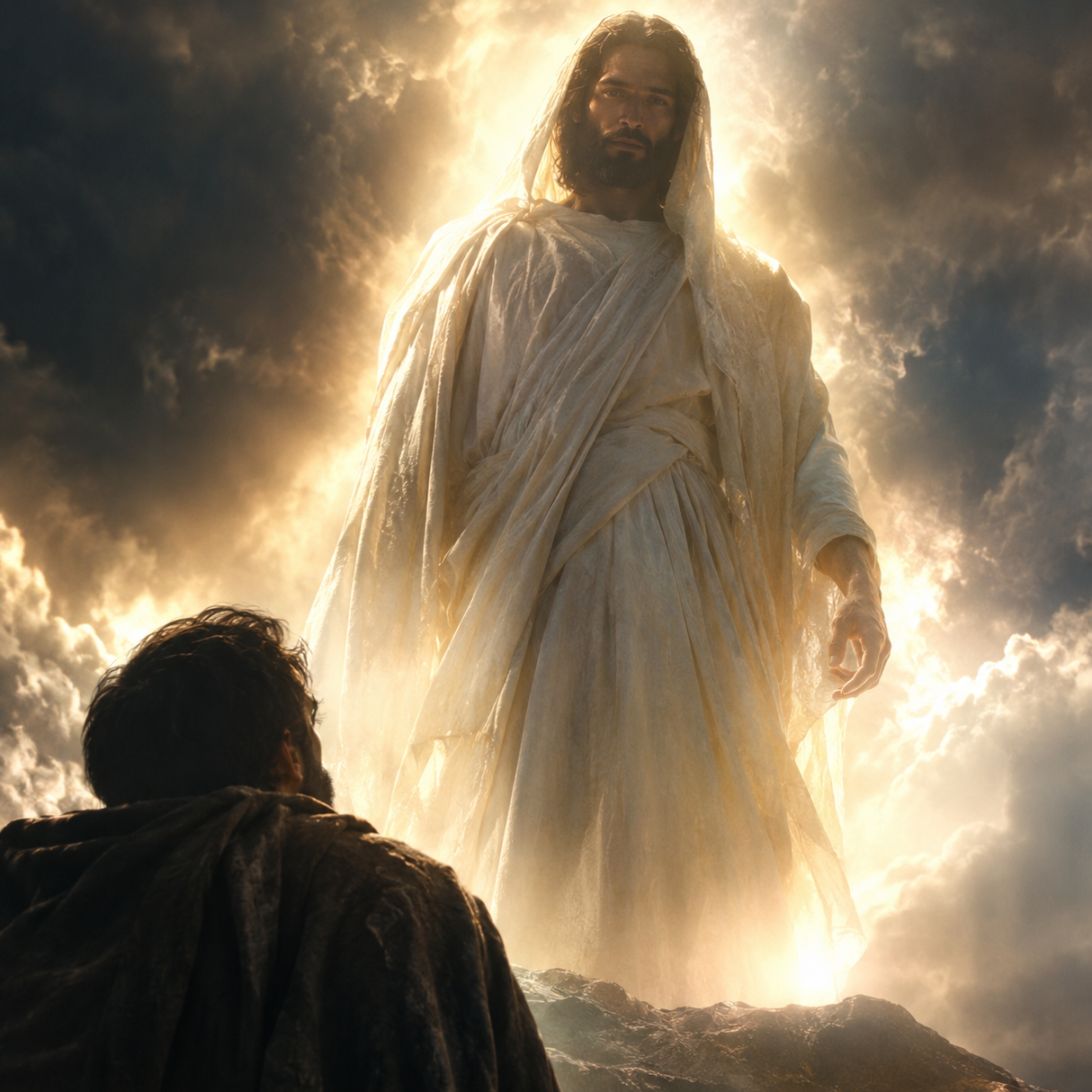
An image generated by ChatGPT that imagines the Man figure written about in the Apocalypse of Abraham.
Section 2: The Heavenly Messiah
Early on in The Scepter and the Star: Messianism in Light of the Dead Sea Scrolls, Collins provides his readers with the typologies of the king, priest, prophet, and heavenly messiah to frame the broader concept of messianism as constructed from eschatological texts, including texts that do not use the term messiah (Collins 2010, 18). The heavenly messiah is distinguished from the other categories as a transcendent, superhuman savior who descends from Heaven during the eschaton who will complete various preordained tasks, depending on the text in question (Collins 2010, 18).
It is evident from various texts that although the figure of the heavenly messiah was idealized as superior to ordinary humans, he was distinct from YHWH and did not necessitate individual worship. For example, Collins writes that, “In Psalm 45 the king is addressed as אלהים, “God”… While the king was not to be confused with the Almighty, he was exalted above the common rank of humanity.” (Collins 2010, 26). These Second Temple Period beliefs of heavenly messianism thus portray a figure with quasi-divinity and greater power than that of ordinary human beings, but not on the same level as YHWH.
In this section’s discussion of the heavenly messiah, we will first begin with drawing upon 4 Ezra, given that this is one of the texts that scholars such as Emil Schürer and George Foot Moore had available before the discoveries near Khirbet Qumran.
Although the text of 4 Ezra focuses on providing consolation to the Jewish people amid a period of great suffering (which may date it to immediately after the destruction of the Second Temple in 70 AD/CE) and various components of it may reflect later Christian redactions (“ESDRAS, BOOKS OF - JewishEncyclopedia.Com,” n.d.), the relevant portions of this text for this paper lie in the descriptions of the figure referred to as the Messiah. Consider the following passage:
For behold, the time will come, when the signs which I have foretold to you will come to pass, that the city which now is not seen shall appear, and the land which now is hidden shall be disclosed. And every one who has been delivered from the evils that I have foretold shall see my wonders. For my son the Messiah shall be revealed with those who are with him, and those who remain shall rejoice four hundred years. And after these years my son the Messiah shall die, and all who draw human breath. (4 Ezra 7:26–29)
This passage provides a conceptualization of a heavenly savior figure whose origins lie in Heaven with YHWH, and not on Earth, and whose role involves a length of rule well beyond any normal human lifespan and saving those whose faith remains with YHWH. Interestingly, verse 29 foretells the death of the Messiah, despite his stature as a heavenly entity, which suggests that heavenly angelic messianic figures may have adopted the functions and limitations of earthly human messiahs, as noted by Collins earlier in this paper. The fusion of both heavenly angelic and earthly human messianic tropes is further exemplified by the following passages from 4 Ezra:
[T]his is the Messiah whom the Most High has kept until the end of days, who will arise from the posterity of David, and will come and speak to them; he will denounce them for their ungodliness and for their wickedness, and will cast up before them their contemptuous dealings. For first he will set them living before his judgment seat, and when he has reproved them, then he will destroy them. But he will deliver in mercy the remnant of my people, those who have been saved throughout my borders, and he will make them joyful until the end comes, the day of judgment, of which I spoke to you at the beginning. (4 Ezra 12:32-34)
This is the interpretation of the vision: As for your seeing a man come up from the heart of the sea, this is he whom the Most High has been keeping for many ages, who will himself deliver his creation; and he will direct those who are left. And as for your seeing wind and fire and a storm coming out of his mouth, and as for his not holding a spear or weapon of war, yet destroying the onrushing multitude which came to conquer him, this is the interpretation: Behold, the days are coming when the Most High will deliver those who are on the earth. (4 Ezra 13:25-29)
On one hand, the quoted text from chapter 12 reveals to us a belief in a coming messiah who is descended from David. Yet, on the other hand, the texts from chapter 13 frame the messiah as someone who has been kept with YHWH in Heaven and, on behalf of YHWH, saves the faithful remnant of humanity from destruction. The value of 4 Ezra lies in its apparent description of messiah that, while holding elements and tropes of an earthly human messiah (such as descent from David), nevertheless has his ultimate origins as a heavenly entity with superhuman ability and authority. The messianic figure in 4 Ezra is described as being separate from YHWH, contrary to the way that Christian traditionalists ascribe Jesus’ place in the Trinity, but the Messiah of 4 Ezra nonetheless possesses divine authority bestowed onto him by YHWH. Thus, 4 Ezra provides us with a concrete example of an ancient Jewish text other than the New Testament gospels with a messianic figure of heavenly origins but earthly characteristics.
The predestined death and/or suffering of messiahs with heavenly origins is not unique to either 4 Ezra or the New Testament gospels. We now turn to the Apocalypse of Abraham, which depicts a heavenly messiah that undergoes persecution.
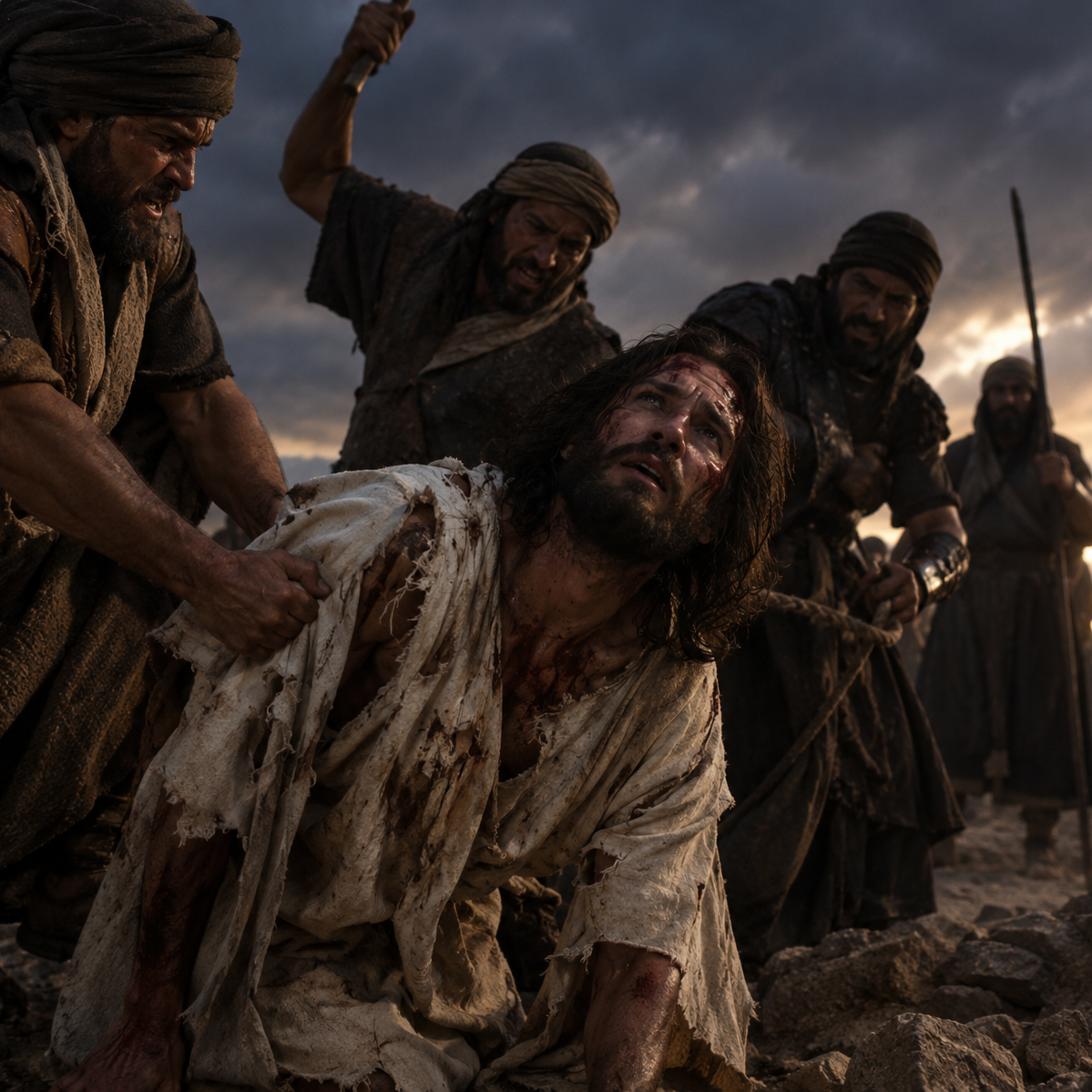
An image generated by ChatGPT that imagines the Man of the Apocalypse of Abraham suffering from persecution.
No manuscripts of the Apocalypse of Abraham (hereafter referred to as “Ap. Abr.”) survive in an original Semitic language or a secondary Greek translation (Box et al. 1918). In the case of Ap. Abr., we have the Christian dualist Bogomil sect of Slavonic-speaking Old Bulgaria to thank for maintaining this text (Box et al. 1918). Given that we have no original Semitic copy of the text and that the text was not incorporated into any religious canon early in antiquity, one might be tempted to see Ap. Abr. as a later Christian text posing as Second Temple Period scripture. This is not the case.
Though the earliest copies we have of Ap. Abr. are in Slavonic, scholars seemed to have accepted that this was an original Jewish text from antiquity. Linguistically, the text of Ap. Abr. exhibits elements that most plausibly point to an original Semitic composition, although whether the author composed the original vorlage in Hebrew, Aramaic, or a mixture of the two remains uncertain (Orlov, n.d.). To quote G. H. Box, “The simple co-ordination of the sentences, the naïve repetitions, and the frequency of the phrase “Here am I” (= Hebrew hinnënî), which characterise all parts of the Book, point in this direction.” (Box et al. 1918, 10).
The dating for the original composition of the Ap. Abr. remains unclear. The consensus among scholars, including G.H. Box and Alexander Kulik, has settled on the idea that the lamentations of Abraham in chapter 27 for the destruction of the Temple in Jerusalem necessitates a composition after 70 AD/CE (Orlov, n.d.). Though this dating of the composition of Ap. Abr. occurs after Jesus’ crucifixion, it should be emphasized that this text, like 4 Ezra, does not automatically reflect Christian authorship or influence.
For one, Ap. Abr. was not included in the Christian canon. The fact that the Bogomils preserved the text may reveal some insight about them as a sect, but that does not logically point to Christian authorship. Secondly, the titles given the eschatological figure depicted in chapters 29 and 31 do not include “Messiah.” This is telling, because, as William Green attests, “early Christian writers gave Jesus a surname… they elected christos, the Greek for masshiah, to attach to Jesus’ name … the usage valorizes christos and thereby makes “messiah” seem a revealing and important category.” (Green 1987, 4). Had early Christians written Ap. Abr., it seems unlikely that they would have withheld the title “Anointed One/Messiah” from the enigmatic messianic character.
Rather than representing an early Christian work, different scholars and commentators have surmised sectarian Jewish origins for the text. G.H. Box believed that the predestinarian, dualistic, and ascetic elements in the text point to an Essene origin (“The Apocalypse of Abraham,” n.d.). However, as clarified by Andrei Orlov, to date, no study has submitted a convincing connection between Ap. Abr. with the Essenes and/or the Dead Sea Scrolls (Orlov, n.d.).
Regardless of which Jewish group originally composed Ap. Abr., the key point of consideration for this paper lie on the fact that it existed in the Jewish milieu of the 1st century AD/CE that the early Christians belonged to. The analysis of the eschatological figure of Ap. Abr. therefore provides another example of a heavenly messiah that pervaded, to some degree, within contemporary Jewish circles of the time. More importantly, the heavenly messiah of Ap. Abr. endures persecution at the hands of sinners, which allows us to consider that early Christians did not invent the notion of a suffering heavenly messiah, but rather used the concept to frame their understanding of Jesus.
The divine attributes of the messianic figure portrayed in Ap. Abr. are immediately recognizable in passages like the following from chapter 31:
And then I will sound the trumpet out of the air, and will send mine Elect One, having in him all my power, one measure; and this one shall summon my despised people from the nations. (Box et al. 1918, 54)
The author of Ap. Abr. explicitly characterizes this described messianic figure as possessing God’s divine power. Hence, like the Messiah of 4 Ezra, this Messiah of Ap. Abr. wields superhuman powers that elevate him beyond a mortal earthly human.
What marks the Messiah of Ap. Abr. as unique from other examples of angelic heavenly messiahs is an explicit reference to enduring ill-treatment from the unrighteous.
And I [looked and] saw a man going out from the left side of the heathen; and there went out men and women and children, from the side of the heathen, many hosts, and worshipped him. And while I still looked there came out from the right side (many), and some insulted that man, while some struck him; …And I said: “O Eternal, Mighty One! Who is the man insulted and beaten, who is worshipped by the heathen with Azazel?” And He answered and said: “Hear, Abraham! The man whom thou sawest insulted and beaten and again worshipped—that is the relief (granted) by the heathen to the people who proceed from thee, in the last days, in this twelfth hour of the Age of ungodliness. (Box et al. 1918, 50)
Notably, the quoted text from chapter 29 does not mention the Messiah of Ap. Abr. dying and resurrecting, which would otherwise be a sign of early Christian authorship. However, the underlying concept of a superhuman messianic figure that suffers at the hands of sinful humans as part of a predestined plan allows us to consider how early Christians may not have invented the notion of the necessity of a messiah suffering as part of a predestined plan of redemption.
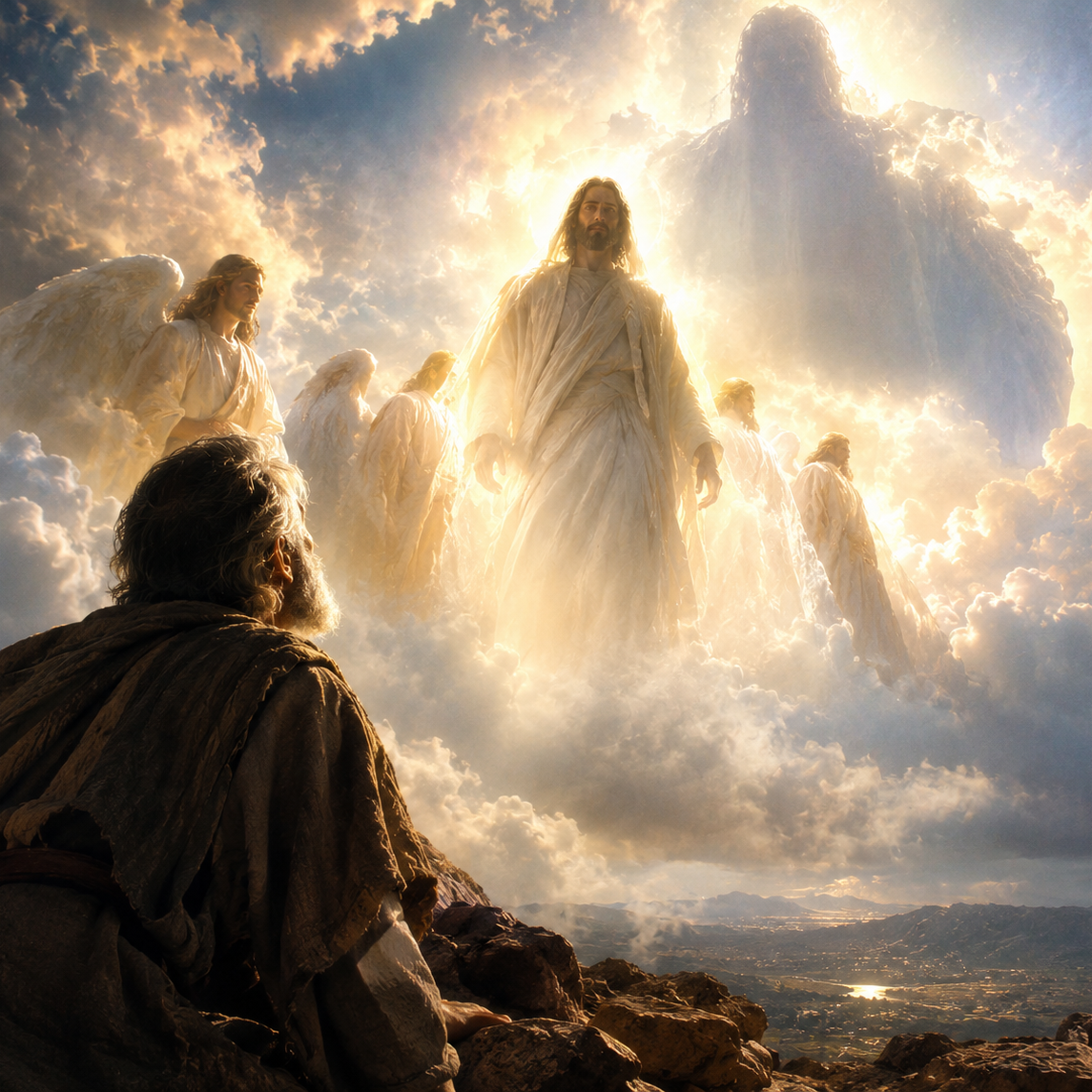
An image generated by ChatGPT that imagines Enoch witnessing the Messiah as described in the Similitudes of 1 Enoch.
The last text that will be overviewed for this section will be 1 Enoch. The value of 1 Enoch for this paper lies with the eschatological figure introduced in the section of the text known as the “Similitudes of Enoch” (known alternatively as the Book of Parables), which covers chapters 37 – 71. In his essay “Salvation without and with a Messiah,” George W.E. Nickelsburg duly notes how the eschatological figure introduced in the Similitudes (hereafter referred to as “the Enochic Messiah”) is only twice referred to as the “Anointed One” (“messiah”), and instead is more commonly associated with the titles “Son of Man” and “Chosen One.” (Nickelsburg 1987, 65) However, Nickelsburg explains that the four names given to the Enochic Messiah – “the Chosen/Elect One”, “the Righteous One”, “the Son of Man”, and “the Anointed One” (messiah) – connect him to characters from Biblical texts, such as the enigmatic “son of man” figure in the Book of Daniel and the Servant of the Lord from the Deutero-Isaianic texts from the Book of Isaiah (Nickelsburg 1987, 58). Moreover, employing multiple titles for the Enochic Messiah allowed the author of 1 Enoch to elevate his messianic character from a human descendant of David to an angelic being originating in Heaven. In Nickelsburg’s words, “By conflating the messianic tradition with the other two, the author depicts the Messiah not as the human son of David, but as a transcendent figure.” (Nickelsburg 1987, 65).
We should note that the Similitudes differ from the rest of 1 Enoch in their emphasis on soteriology and eschatological judgment, the latter of which is administered by the messianic figure (Nickelsburg 1987, 56). According to Nickelsburg, the theme of divine judgment and the role of the Enochic Messiah represents the “latest stratum” in the composition of 1 Enoch, because, “A tradent of Enochic tradition or a group of such sages have drawn materials from outside this tradition and created a composite figure to serve the judicial and salvific functions that the earlier Enochic traditions ascribed to men, angels, and God.” (Nickelsburg 1987, 56).
It should also be noted that the text fragments of 1 Enoch found among the Dead Sea Scrolls at Qumran do not include portions of the Similitudes (“Enoch in the Old Testament and Beyond | Religious Studies Center,” n.d.), and thus we cannot assume that the sect at Qumran believed in the Enochic Messiah ascribed in the Similitudes. In fact, without the preservation efforts of the Ethiopian Orthodox Tewahedo Church, the complete text of 1 Enoch would have been lost (“1 Enoch,” n.d.).
Nonetheless, the theological and literary themes of the Similitudes suggest that it was most likely composed during the last century of the Second Temple Period, if not soon after the destruction of the Second Temple in 70 AD/CE (“Enoch in the Old Testament and Beyond | Religious Studies Center,” n.d.). James Charlesworth, quoted by Nickelsburg, surmises that the Similitudes were added to the other sections of the text sometime between the 1st century BC/BCE[1] and the end of the 1st century AD/CE (Nickelsburg 1987, 65). Nickelsburg himself notes that the Enochic Messiah was a figure that influenced later angelic heavenly messiahs after the Roman conquest of Jerusalem in 70 AD/CE (Nickelsburg 1987, 65). Therefore, the character of the Enochic Messiah would have likely developed in parallel to the budding early Christian movement even if the Similitudes were not composed prior to Jesus’ crucifixion.
The Enochic Messiah is fundamental for the archetypical development of the angelic heavenly messiah because of his predestined mission and for the nature of his origins. As Nickelsburg notes, “He is not the kind of Messiah described in texts that await a Davidic king or a Levitic priest.” (Nickelsburg 1987, 56). In his speculation on how the Enochic Messiah might have influenced the New Testament gospels, David Flusser writes that, “The Son of Man has a superhuman, heavenly sublimity. He is the cosmic judge at the end of time. Sitting upon the throne of God … he will consign the just to blessedness and the wicked to the pit of hell.” (Flusser and Notley 1998, 129–30).
In terms of the actual text, the author of the Similitudes makes it clear to his readers that the Enochic Messiah exists as superior to all other created beings. Chapter 46[2] reads:
This is the Son of man, to whom righteousness belongs; with whom righteousness has dwelt; and who will reveal all the treasures of that which is concealed: for the Lord of spirits has chosen him; and his portion has surpassed all before the Lord of spirits in everlasting uprightness. (Laurence 1883 46:2)
Additionally, consider the following verses:
Therefore the Elect and the Concealed One existed in his presence, before the world was created, and for ever. In his presence he existed, and has revealed to the saints and to the righteous the wisdom of the Lord of spirits; for he has preserved the lot of the righteous, because they have hated and rejected this world of iniquity, and have detested all its works and ways, in the name of the Lord of spirits. (Laurence 1883 48:5–6)
These verses, among others, demonstrate how the author of the Similitudes believed in a heavenly messianic savior whose destiny is not only mandated by God, but whose very origin is connected to YHWH like no other being. As Nickelsburg aptly puts it, “As the one whom the Lord of Spirits has chosen… he is the highest functionary in the heavenly court – thus surpassing in rank even the four archangels, Michael, Raphael, Gabriel, and Phanuel.” (Nickelsburg 1987, 59).
The author of the Similitudes casts the Enochic Messiah as the most exalted of God’s creations, but at the same time makes it obvious that he occupies a secondary and subservient position to YHWH, as can be observed from the following verses from chapter 48:
He shall be the hope of those whose hearts are troubled. All, who dwell on earth, shall fall down and worship before him; shall bless and glorify him, and sing praises to the name of the Lord of spirits.(Laurence 1883 48:4)
In his presence shall they fall, and not be raised up again; nor shall there be any one to take them out of his hands, and to lift them up: for they have denied the Lord of spirits, and his Messiah. The name of the Lord of spirits shall be blessed. (Laurence 1883 48:11)
Even though the author of the Similitudes describes the Enochic Messiah as a quasi-divine heavenly being, only YHWH remains the object of praise. Even though 48:4 describes the righteous blessing and worshipping the Enochic Messiah, it is the Lord of Spirits who receives humanity's ultimate dedication, not the Enochic Messiah. It is the Lord of Spirits whose name shall be blessed, whereas the true name of the Enochic Messiah is never even considered. Verse 3 of chapter 45 notes that,
In that day shall the Elect One sit upon a throne of glory; and shall choose their conditions and countless habitations, while their spirits within them shall be strengthened, when they behold my Elect One, for those who have fled for protection to my holy and glorious name. (Laurence 1883 45:3)
Even when the Enochic Messiah assumes authority upon a throne in Heaven, YHWH proves supreme in that the invocation of his name will provide salvation for the righteous. To use Nickelsburg’s wording, “The central figure of the Parables is God’s heavenly vice-regent.” (Nickelsburg 1987, 63). A vice-regent may exercise regal authority, but a vice-regent does not command subservience in the manner of a king.
The Enochic Messiah provides us with an example of a developed messianic ideal where the Messiah is conceptualized as first and foremost a heavenly agent of God whose divine origins transcend mere human existence. Like Ap. Abr., the dating of the Similitudes may be contestable. Nevertheless, the Similitudes became widespread, at the latest, around the same time that Jesus’ followers began developing their community. The Epistle of Jude shows us that at least some of the early Christians were familiar with Enochic literature, and therefore it certainly remains plausible that some in the emerging Christian movement came across the Similitudes. Most importantly, the Similitudes illustrate a firm example of how various Jewish groups of the Second Temple Period adopted a formulation of a coming angelic heavenly messiah who would reign above all angels and humans while still remaining subordinate to and separate from YHWH.
It is worth noting that towards the end of his “Salvation without and with a Messiah” essay, Nickelsburg briefly elaborates on his belief of how the Enochic Messiah also embodies the trope of “an exalted persecuted righteous man” (Nickelsburg 1987, 64). He does so, however, without any explicit textual reference and instead builds his argument by attempting to link the Enochic Messiah with the character of “the Righteous One” figure from the Wisdom of Solomon (Nickelsburg 1987, 64). As interesting as Nickelsburg’s belief on this matter may be, it proves too speculative for us to adopt without skepticism.
The examples of the angel-like heavenly messiahs depicted in 4 Ezra, Ap. Abr., and the Similitudes of 1 Enoch demonstrate that the concept of a messianic figure with origins in Heaven and possessing divine authority and powers granted by YHWH developed concurrently with the early formation of the Christian faith. Whereas the only Jewish texts from the 1st century AD/CE that are claimed as espousing a messiah who is co-equal and co-eternal with YHWH come from the New Testament, this section demonstrates that multiple texts from the time period envisioned a heavenly, transcendent messiah with superhuman attributes who served as a chief lieutenant to God. Considerations of the Christological claims about Jesus in the New Testament are therefore not wholly dependent on the Trinitarian notions of the Messiah as co-equal and co-eternal with YHWH, but rather can be measured with the examples of angelic heavenly messiahs from contemporary texts.
[1] Stylistic note: I combine both traditional and more modern academic standards for year phrasing for idiosyncratic purposes, so that specific year dates read “BC/BCE” and “AD/CE” rather than one or the other.
[2] References follow Laurence’s 1883 versification, which differs from the numbering in the Charles and in Nickelsburg–VanderKam translations.
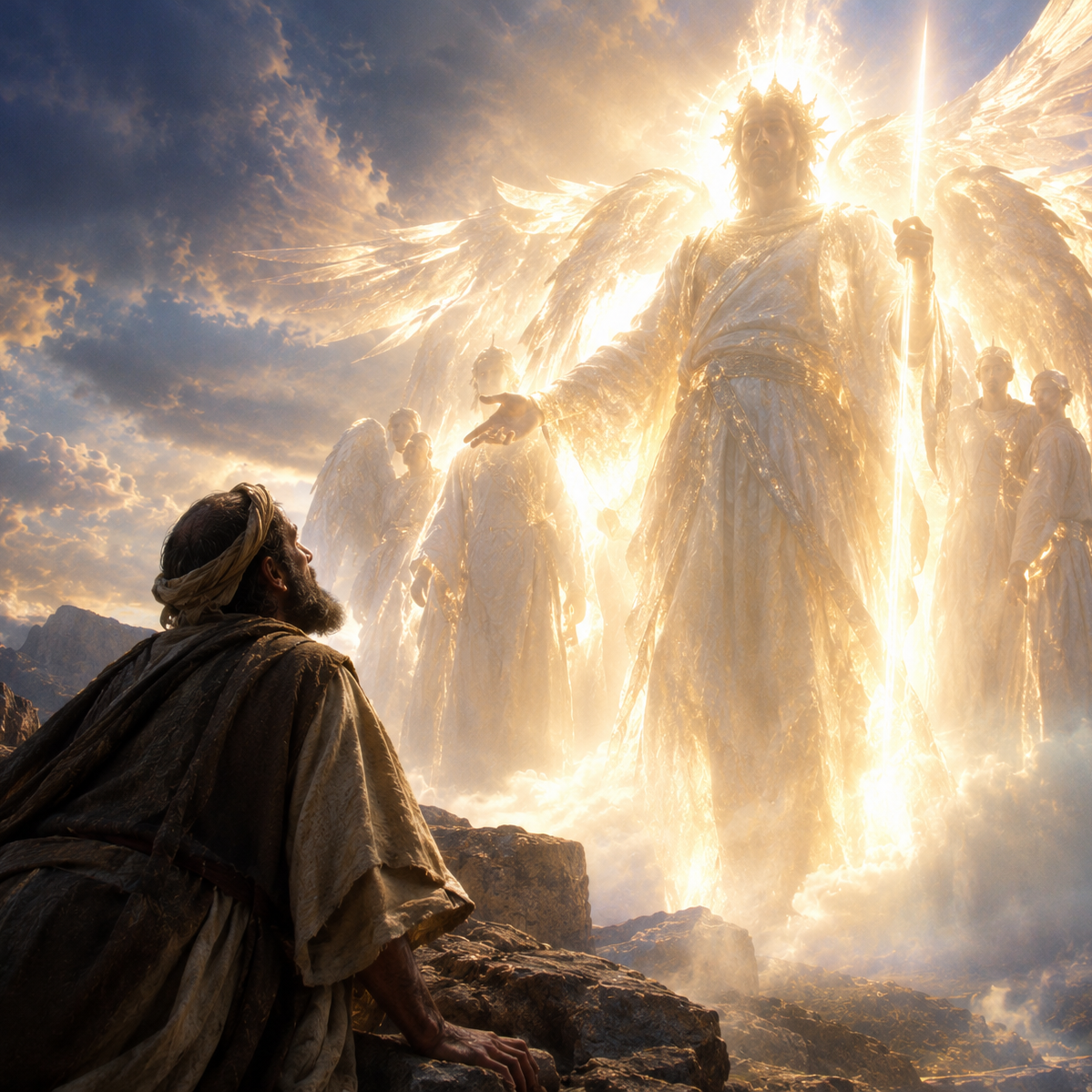
An image generated by ChatGPT that imagines Rabbi Ishmael witnessing Metatron, the ascended Enoch, as described in 3 Enoch.
Section 3: Ascended Humans
From the previous section, we can readily consider how prevalent the concept of an angelic messiah who would one day descend to Earth from Heaven may have been amongst the wider Jewish world of the 1st century AD/CE. However, the heavenly messiah who descends from Heaven is not the only version of an angelic superhuman that existed in Jewish literature at the time. Collins notes that the Book of Zechariah exemplifies how the eschaton may elevate human beings to an angelic and godlike status, but not of Godhood itself: “Zech 12:8, however, looks forward to a time when the house of David will be like a god (אלהים) and like an angel of the Lord.” (Collins 2010, 38).
This section will not touch upon the Book of Zechariah specifically, but rather will analyze three different Jewish texts that involve a human figure who ascends to Heaven as a transformed angelic being. The first is 4Q491c, conventionally called the Self-Glorification Hymn; Vermes titles it ‘Glorification Hymn A.’
However, before delving into the Self-Glorification Hymn, it is worth preemptively addressing hesitations with any reliance on the Qumran texts to assume broader trends in the Jewish populations of the time. Although this paper has mentioned earlier how the discoveries at Qumran greatly impacted the academic study of messianism, we should recognize that the highly sectarian nature of the group at Qumran (regardless of whether they were in fact Essenes or some other group) perhaps should give us pause as to whether any texts found at the site are indicative of broader cultural and ideological trends in Judea or simply markers of the religious peculiarities of the group. The fact that Khirbet Qumran was, at the time, relatively geographically isolated from major Jewish urban areas given its location near the northwestern shores of the Dead Sea further complicates any attempt to extrapolate from the Qumran findings.
Nevertheless, though the texts that are unique to Qumran may not automatically be assumed to have occupied widespread acceptance or belief among Jewish groups during the Second Temple Period, they represent tangible evidence that at least some religious streams in Judea at the time had diverse views on angels and messianism. The following quote from the late Shemaryahu Talmon puts it well:
The new discovery provided firsthand evidence for trends of religious developments that affected Judaism toward the end of the Second Temple Period, that is to say, in the last phase of Jewish political sovereignty, which in part preceded and in part coincided with the emergence of Christianity. The scrolls reflect the credal concepts of a group of dissenters who propounded an extreme Messianism. They indeed parted company with proto-Pharisaic Judaism, but never amalgamated with Christianity. A probe into their socioreligious history should thus provide new, albeit indirect, information on the contemporary messianic concepts of rabbinic Judaism and of nascent Christendom, whether by pointing out similarities the Qumran community shared with either, or else by highlighting views that contrasted with one or the other, or with both. (Talmon 1987, 113)
That said, we will now turn to the Self-Glorification Hymn.
The text of the Self-Glorification Hymn, while relatively short, provides a fascinating insight into how members of the Qumran sect viewed the possibility of ascending into a position of quasi-divinity. The hymn, written from the perspective of an unknown narrator, describes the ability of someone to assume a position of equality with demi-gods and angels. Consider the following quote:
I am reckoned with the ‘gods’ and my dwelling-place is in the congregation of holiness. (Vermes 2004, 397)
The most interesting line for the purposes of this paper, however, is the declaration from the narrator towards the end of the hymn.
Who shall summon me to be destroyed by my judgement? (Vermes 2004, 398)
The notion of the narrator as immune to an act of judgment suggests that he has become like an angel in that he is not vulnerable to divine judgment in the way that humans are. Notably, the narrator of the Self-Glorification Hymn does not assume to speak as an angelic being who originates from Heaven. Rather, the narrator seems to imply that he is a human who has assumed a transformative position of quasi-divine power.
It may be impossible to say for certain whether the theme of the human narrator in the Self-Glorification Hymn becoming a figure of some peer status with angels was originally meant to be read figuratively as a work of poetry rather than literally as a text of theological belief. Regardless, the invocation of the idea of a human ascending to a position with angels and wielding powerful judgment prepares us to consider the figure of Metatron in 3 Enoch.
The text of 3 Enoch requires its own preface for the purposes of this paper. More so than even 4 Ezra or Ap. Abr., 3 Enoch is far removed from the destruction of the Second Temple, and therefore at a first glance its inclusion in this discussion may seem odd. Unlike for 4 Ezra, Ap. Abr., and the Similitudes of 1 Enoch, we have original Hebrew manuscripts of 3 Enoch. While the narration of 3 Enoch purports that the text itself is the writing of Rabbi Ishmael from the 2nd century AD/CE, most scholars believe its earliest origin traces to the 5th century AD/CE (Alexander 2010, 229). Even if we were to assume a 2nd century authorship, this still makes the text notably removed from the Second Temple Period and not necessarily indicative of any thinking that may have existed during Jesus’ ministry.
Nevertheless, 3 Enoch still has value to offer any discussion on Second Temple Period messianism. The theological notions present in the text could be the result of development in Jewish religious concepts, particularly those within streams of mysticism, that occurred in the centuries following the destruction of the Second Temple. However, 3 Enoch could also be evidence of a text that preserved ideas that traced back to the Second Temple Period. In his defense for including rabbinic texts from the Talmud in his analysis of Jesus in the introduction for Early Jewish Messianism in the New Testament: Reflections in the Dim Mirror, Serge Ruzer writes,
It comes as no surprise that models of independent, parallel developments and of Christian influence on the rabbinic tradition, with the latter polemically responding to the former, are nowadays more in vogue as suggested solutions. I will try to salvage at least something from the thought of that earlier 'innocent' Strack-Billerbeck period - before being condemned as anachronistic parallelomania - as having a potential for elucidating the links between nascent Christianity and its Jewish religious milieu, but with a twist. I will be mainly dealing with cases where, on the one hand, no polemical overtones are discerned in the rabbinic parallel, which is overlooking the proximity to the foundational Christian narrative and missing, one may say, the opportunity to be engaged in polemics, and, on the other hand, an overly detailed overlap seems to preclude wholly independent trajectories. (Ruzer 2020, 8–9)
Likewise, this paper, at the risk of falling into “parallelomania,” will include the concept of angelic ascension in 3 Enoch because it seems to complement similar beliefs found in the two texts from Qumran that this section covers.
The figure of Metatron in 3 Enoch proves fascinating in that he explicitly announces himself as the transformed version of Enoch.
I asked Metatron and said to him: “Why art thou called by the name of thy Creator, by seventy names? Thou art greater than all the princes, higher than all the angels, beloved more than all the servants, honoured above all the mighty ones in kingship, greatness and glory: why do they call thee ‘Youth’ in the high heavens?” He answered and said to me: “Because I am Enoch, the son of Jared.” (Odeberg, 1928 ch. IV verses 1–2)
Metatron’s answer to Rabbi Ishmael is blunt and to the point. Enoch, son of Jared, as a well-known figure from the Book of Genesis, needs no introduction. Rather, the revelation of his earthly origin to Rabbi Ishmael illuminates how the writer of this text, whomever that person was, believed that Enoch’s ascension to Heaven as a chief angelic vice-regent to YHWH best explains the otherwise cryptic statement in Genesis 5:24 of how “Enoch walked faithfully with God; then he was no more, because God took him away.” (NIV).
What is equally fascinating is how 3 Enoch describes the considerable power that Metatron wields, particularly in comparison with the older and more established angels, as noted in the following passages.
God places Metatron on a throne at the door of the seventh Hall and announces through the Herald, that Metatron henceforth is God's representative and ruler over all the princes of kingdoms and all the children of heaven, save the eight high princes called YHWH by the name of their King.(Odeberg, Hugo, n.d., chap. 10)
And the herald went forth into every heaven, saying: This is Metatron, my servant. I have made him into a prince and a ruler over all the princes of my kingdoms and over all the children of heaven, except the eight great princes, the honoured and revered ones who are called YHWH, by the name of their King. (Odeberg, Hugo, n.d., 10:3)
Even Sammael, the Prince of the Accusers, who is greater than all the princes of kingdoms on high; feared and trembled before me. (Odeberg, Hugo, n.d., 14:2)
If this were not impressive enough, 3 Enoch goes into repetitive detail in how YHWH empowered Enoch, originally a mere man, into becoming an entity of power second only to YHWH.
I seized him, and I took him and I appointed him that is Enoch, the son of Jared, whose name is Metatron and I took him from among the children of men and made him a Throne over against my Throne.(Odeberg, Hugo, n.d., chap. 48c)
And I committed to him Wisdom and Intelligence more than (to) all the angels. And I called his name “the LESSER YAH”, whose name is by Gematria 71. And I arranged for him all the works of Creation. And I made his power to transcend (lit. I made for him power more than) all the ministering angels. (Odeberg, Hugo, n.d., 12:5)
Metatron’s empowerment as YHWH’s chief lieutenant and master of all other angelic beings in Heaven should be duly noted as not dissimilar to the description of the angelic messiahs in 4 Ezra and the Similitudes of 1 Enoch. Moreover, the idea of a being that formerly existed as a human who then ascended to Heaven and wielded authority over all but YHWH parallels the development of Jesus in the New Testament gospels.
Though Metatron in 3 Enoch serves as the preeminent entity under YHWH and the narrator of the Self-Glorification Hymn describes himself as an angel-like entity with powers of judgment, neither figure can be said to occupy the position of an eschatological savior. In other words, neither can be accurately described as a messiah.
There is one text, however, that tells of an eschatological judge residing in Heaven who once lived as a man. The last text for this section has us return to Qumran, where we will look at 11Q13, otherwise known as The Heavenly Prince Melchizedek Text (hereafter referred to as “HPM”).
In preparing his reader for the text of HPM, Vermes writes,
The heavenly deliverer is Melchizedek. Identical with the archangel Michael, he is the head of the ‘sons of Heaven’ or ‘gods of Justice’ and is referred to as elohim and el. The same terminology occurs in the Songs for the Holocaust of the Sabbath [“Songs of the Sabbath Sacrifice”]. These Hebrew words normally mean ‘God’, but in certain specific contexts Jewish tradition also explains elohim as primarily designating a ‘judge.’ (Vermes 2004, 585)
While Vermes identifies the Melchizedek of the text as the Archangel Michael, the figure’s name clearly refers to the human king of Salem and priest of El Elyon in Genesis 14:18–20. The text of HPM casts Melchizedek as a clearly eschatological angelic figure, as evidenced by the following passages.
Its interpretation is that He will assign them to the Sons of Heaven and to the inheritance of Melchizedek; f[or He will cast] their [lot] amid the po[rtions of Melchize]dek, who will return them there and will proclaim to them liberty, forgiving them [the wrong-doings] of all their iniquities. (Vermes 2004, 585)
In addition to ranking alongside the “Sons of Heaven” (angels), YHWH assigns Melchizedek the task of forgiving humans of their sins and saving them from evil. Despite the short breadth of the text, the idea is hammered home.
For this is the moment of the Year of Grace for Melchizedek. [And h]e will, by his strength, judge the holy ones of God, executing judgement as it is written concerning him in the Songs of David, who said, ELOHIM has taken his place in the divine council; in the midst of the gods he holds judgement. (Vermes 2004, 585)
And your ELOHIM is [Melchizedek, who will save them from] the hand of Belial. (Vermes 2004, 586)
The forgiveness of sins as described in the text parallels the general idea of forgiveness in the canonical texts of the Hebrew Bible, such as Jeremiah 31:34 and Micah 7:18–19. However, unlike verses from the Hebrew Scriptures in which YHWH directly forgives humanity, HPM has Melchizedek assume that role. Moreover, as Vermes noted, Melchizedek does not do so in the form of the human king and priest of Genesis 14, but as a high-ranking angelic savior under YHWH.
HPM describes Melchizedek as possessing such high Heavenly authority that it goes as far as to tell its reader that Melchizedek has the ability to deliver divine judgment. As we prepare to move into the next section focusing on Jesus, it should remain central to us that at least one Jewish group of the Second Temple Period had formulated an idea of a human-turned-angel who would forgive sins on behalf of YHWH. From HPM, not only do we have evidence to link the belief in 3 Enoch of an all-powerful angel who once lived as a man, but we can now also point to a text where such a being even serves as a heavenly eschatological authority who can deliver divine justice similar to the messiahs of 4 Ezra and 1 Enoch.
Had HPM existed in isolation, we could perhaps dismiss it as an oddity. However, when considered alongside the Self-Glorification Hymn and 3 Enoch, we can appreciate how the idea of humans ascending to angelic status could have existed in some force during the Second Temple Period. Whereas the texts of the previous section imagined heavenly messiahs who descended from Heaven, the literature in this section allowed us to sample the alternative theological undercurrent that foresaw a human from Earth ascending to the position of angelic savior. Regardless of which direction to or from Heaven the angelic heavenly messiah is described as going towards, the texts overviewed in both sections force us to confront the possibility that strands of messianism during the Second Temple Period blurred the lines between human and angelic eschatological saviors.
Though the Synoptic Gospels describe Jesus as no more than a man during his ministry, our discussions about the various examples of heavenly messiahs will nonetheless allow us to deliberate on how the Gospel of John intended its readers to receive the Christological statements it attributes to Jesus.
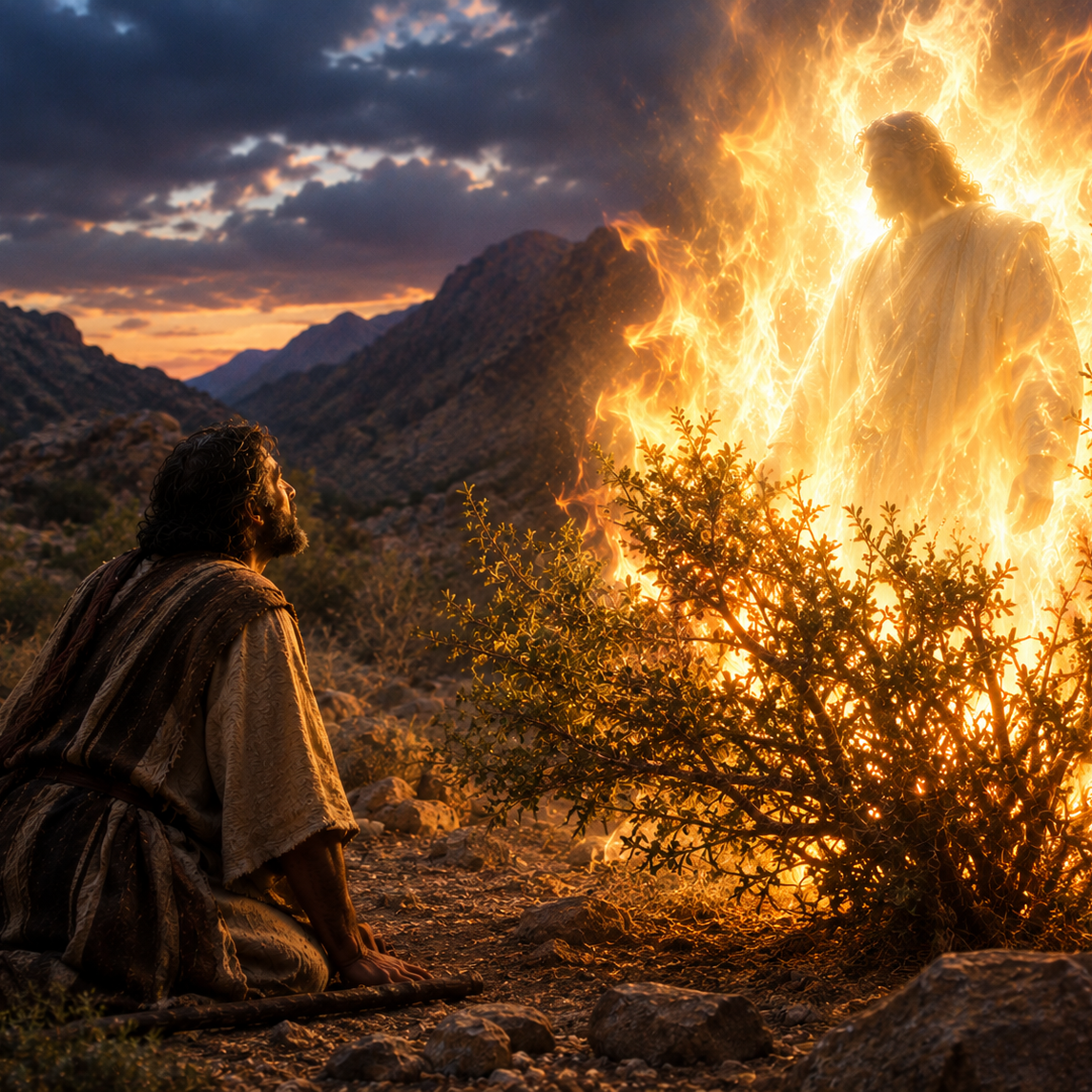
An image generated by ChatGPT that imagines Moses being confronted by the unnamed Angel in the burning bush described in chapter 3 of the Book of Exodus.
Section 4: Christology in the Gospel of John
We now turn our attention to perhaps the most explicit statement Jesus makes about himself in the Gospel of John, which he delivers in chapter 8:
“You are not yet fifty years old,” they said to him, “and you have seen Abraham!”
“Very truly I tell you,” Jesus answered, “before Abraham was born, I am!” (NIV, John 8:57–58)
We will focus on the Christology of the Gospel of John as it is the one Gospel text which scholars acknowledge contains statements about Jesus’ divinity. For example, according to Ehrman, “You do find Jesus calling himself God in the Gospel of John, or the last Gospel. Jesus says things like, “Before Abraham was, I am.”” (Gross 2014).
Moreover, John 8:58 is unique in that it claims to represent an explicit statement that Jesus made about himself. Other Christological verses, such as John 1:1 and 14:9 which state, in the NIV translations, “the Word was with God, and the Word was God,” and, “If you've seen me, you've seen the Father,” respectively, are not as immediately explicit or obvious in comparison to John 8:58 as statements about Jesus being co-equal and co-eternal with YHWH in Godhood.
The declaration in John 8:58 can point to two possibilities. First, the “I am” statement can refer to various statements in Deutero-Isaiah. Consider the following passages from Isaiah in NIV, “I, the Lord – with the first of them and with the last – I am he,” (Isaiah 41:4), “You are my witnesses,” declares the Lord, “and my servant whom I have chosen, so that you may know and believe me and understand that I am he.” (Isaiah 43:10), and “Even to your old age and gray hairs I am he, I am he who will sustain you” (Isaiah 46:4). However, the “I am” phrase can also refer to the earlier utterance of “ehyeh” (אֶהְיֶה) that God makes to Moses in the Book of Exodus.
God said to Moses, “I am who I am. This is what you are to say to the Israelites: ‘I am has sent me to you.’” (NIV, Exodus 3:14)
Chapter 8 of the Gospel of John concludes with a mob of Jesus’ countrymen attempting to stone him at the temple grounds in Jerusalem. The narrative thus has a scene where learned Jews of the Second Temple Period would have been able to link Jesus’ declaration with the text of Exodus 3:14.
However, is it accurate to assume that the Gospel of John wanted its readers to connect Jesus with YHWH? In the burning bush scene of Exodus 3, there is after all another character mentioned in addition to Moses and YHWH.
Now Moses was tending the flock of Jethro his father-in-law, the priest of Midian, and he led the flock to the far side of the wilderness and came to Horeb, the mountain of God. There the angel of the Lord appeared to him in flames of fire from within a bush. (NIV Exodus 3:1-2)
Given that the Hebrew word for angel, “מַלְאָךְ”, literally denotes “messenger”, we can understand that the text implies God as speaking to Moses through the angel. Had it been God, rather than an angel, physically present at Horeb, it stands to reason that this enigmatic “angel of the Lord” would not need to have been mentioned.
Moreover, the manner in which Moses approaches the angel should catch our attention. The text describes YHWH instructing Moses to walk without his sandals before the burning bush.
Take off your sandals, for the place where you are standing is holy ground. (NIV Exodus 3:5)
As YHWH has no physical presence in this scene, the text essentially depicts Moses as taking off his sandals before an angel. The only other instance of a character taking off footwear in respect to some aspect of divinity is in the Book of Joshua.
The commander of the Lord’s army replied, “Take off your sandals, for the place where you are standing is holy.” And Joshua did so. (NIV Joshua 5:15)
Here, Joshua does so not in reverence before YHWH, but before this mysterious heavenly figure, whose exact identity is left unknown beyond the implication that the “commander” assumes great authority in Heaven.
There are phrases that may seem to indicate God does have a physical presence in Exodus, such as in Exodus 3:6: “At this, Moses hid his face, because he was afraid to look at God.” (NIV). However, the angel in Exodus 3 serves as a functionary extension of YHWH just as the heavenly figure in Joshua 5 does, and therefore should be understood as interchangeable with YHWH for narrative purposes. Such interchangeability is functional rather than ontological, however, for the angel at Horeb speaks in YHWH’s own voice and receives Moses’ reverence while remaining a distinct and subordinate figure, precisely the arrangement we have already observed in the Enochic Messiah, whom all who dwell on earth worship even as it is the Lord of Spirits whose name is blessed, and in the Melchizedek of HPM, who is addressed as elohim while executing judgment on YHWH’s behalf. In other words, we should interpret Exodus 3:6 as reading how Moses hid his face from the angel in the burning bush.
When we consider how the various angelic heavenly messiahs in 4 Ezra, Ap. Abr., 1 Enoch, and HPM are described in great detail as holding positions of command over other angels under YHWH, we can begin to entertain the possibility that the claim in John 8:58 attempts to portray Jesus as a quasi-angelic being. Thus, the scene in John 8 when Jesus refers to the “I am” phrase in Exodus 3 should more likely be interpreted as Jesus connecting himself with the angel in the burning bush speaking on behalf of YHWH and not as a declaration of Godhood.
The Jewish crowd described in chapter 8 of the Gospel of John would have certainly been familiar with the texts of both Exodus and Joshua, if not the wider literature about heavenly messiahs of the time. The prevalence of angelic messianic concepts in Judea during Jesus’ time may explain why the author of the Johannine narrative does not bother to explain why the mob confronting Jesus proceeded to attack him after his “I am” declaration. We have no example from the Second Temple Period of a text deliberately describing a messianic figure as co-equal and co-eternal with YHWH. Hence, had the writer of John meant his reader to interpret the “I am” statement as a self-statement of Godhood, he would have been doing so without any prevailing cultural or religious background. Not only readers of the text, but perhaps even the violent crowd in chapter 8 would have thus been more confused than angry or astounded by such an arbitrary and novel declaration of equality with and identity as YHWH. In contrast, as this paper has demonstrated, we have a number of textual examples of angelic heavenly messiahs that can be linked with Exodus and Joshua.
From our analyses into various Jewish texts that describe some version of an angelic heavenly messiah, we can dare to imagine the possibility that the writer of the Gospel of John may have intended the “I am” statement in chapter 8 to be understood as a claim of heavenly messianism as opposed to any theological idea close to modern Christian beliefs of the Trinity.
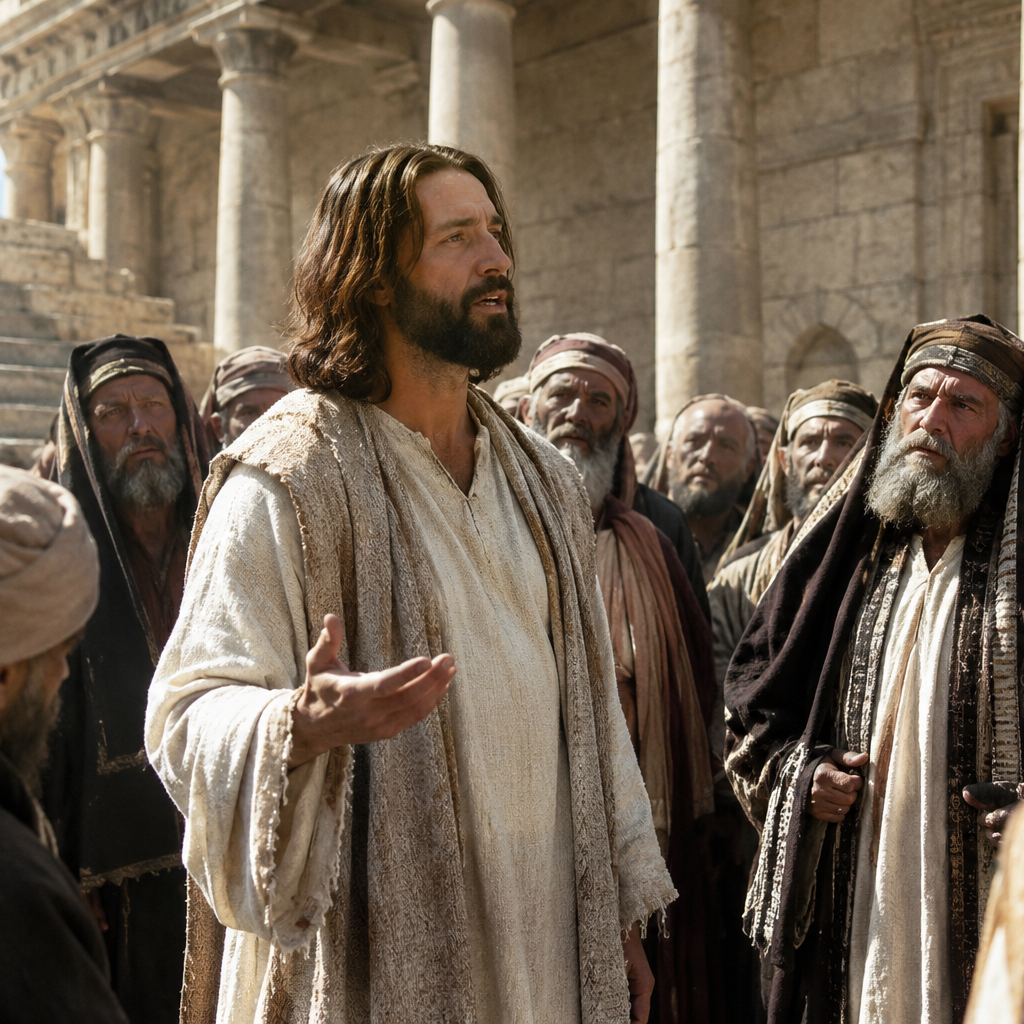
An image generated by ChatGPT that imagines Jesus speaking before a crowd of people in Jerusalem as described in John 8:58.
Conclusion
In the conclusion to chapter 9 of his book Jesus, David Flusser writes, “The one like a man who sits upon the throne of God’s glory, the sublime eschatological judge, is the highest conception of the Redeemer ever developed by ancient Judaism … Could Jesus of Nazareth have understood himself thus?” (Flusser and Notley 1998, 130).
It is beyond the ability of this paper to prove beyond any reasonable doubt what thoughts or intentions the historical Jesus may have had. It is possible, however, to construct plausible arguments as to what the author of the Gospel of John intended for his audiences. The thrust of this paper has been focused on the portrayal of Jesus from the text of the Gospel of John; whether or not the literary figure of Jesus from the Johannine text should be synonymous with the historical Jesus of reality remains a question well beyond the ability of any writer to answer to universal satisfaction.
By overviewing a variety of messianic examples found in various Jewish texts from antiquity, this paper has submitted the case that the author of the Gospel of John relied upon contemporary popular understandings of angelic heavenly messianism when attributing the Christological “I am” statement in chapter 8 to Jesus.
“Far from exhausting the issue, it offers a kind of road map for further investigation.” (Ruzer 2020, 13). The previous quote shows how Ruzer frames his work on early Jewish messianism in the New Testament. Likewise, this paper does not claim any finality about the application of angelic heavenly messianism of various ancient Jewish literature to understandings about the early Christian community and the New Testament texts. Rather, it hopes that the arguments presented promote future contemplation and discussion.
There are further topics and questions that this paper did not explore in order to respect the length limitations for this assignment. Additional Jewish texts, such as the Psalms of Solomon, could be used to further delve into Second Temple Period messianism. Moreover, this paper focused exclusively on the Gospel of John, but a wider and more holistic discussion of Jesus and his claims to messianism would invariably have to include other New Testament texts. Furthermore, future investigations into the influence of beliefs in angelic heavenly messianism on early Christianity would be greatly aided by discussion of the different traditions that deified Moses, such as found in the works of Philo of Alexandria, and compared Jesus with Moses, such as in the Gospel of John itself.
Lastly, if the Gospel of John does indeed promote the idea that Jesus was some version of an angelic heavenly messiah, it would mark a novel case in one regard. Whereas the other messianic texts covered in this paper described an ambiguous angelic savior or elevated a Biblical figure as the coming transcendent heavenly messiah, the Gospel of John stands unique in that it attributed a man known within living memory at the time to such a being. The revolutionary aspect of the Gospel of John would thus lie in its personification of an angelic heavenly messiah rather than in any Trinitarian claim. As to what reasons the Gospel of John’s author and his supporters came to adopt such a belief would be a markedly interesting topic for future writings.
References (Chicago Manual of Style 18th edition, author-date)
“1 Enoch.” n.d. Accessed March 31, 2026. https://www.earlyjewishwritings.com/1enoch.html.
“2 Esdras, 4 Ezra.” n.d. Accessed September 16, 2026. https://www.pseudepigrapha.com/apocrypha_ot/2esdr.htm.
Alexander, P. 2010. 3 (Hebrew Apocalypse of) Enoch. The Old Testament Pseudepigrapha. Hendrickson Publishers.
Bi, Johnathan. 2026. “Transcript of Interview with Dale Allison on New Testament Scholarship.” January 18. https://www.johnathanbi.com/p/transcript-of-interview-with-dale-allison-on-new-testament?utm_medium=email.
Box, G. H., J. I. Landsman, and W. O. E. Oesterley, eds. 1918. Apocalypse of Abraham. Wipf & Stock Publishers.
Collins, John J. 1987. “Messianism in the Maccabean Period.” In Judaisms and Their Messiahs at the Turn of the Christian Era, edited by Jacob Neusner, William Scott Green, and Ernest S. Frerichs, 97–110. Cambridge: Cambridge University Press.
Collins, John J. 2010. The Scepter and the Star: Messianism in Light of the Dead Sea Scrolls. Wm. B. Eerdmans Publishing Co.
“Enoch in the Old Testament and Beyond | Religious Studies Center.” n.d. Accessed March 31, 2026. https://rsc.byu.edu/creation-sinai/enoch-old-testament-beyond.
“ESDRAS, BOOKS OF - JewishEncyclopedia.Com.” n.d. Accessed September 16, 2026. https://jewishencyclopedia.com/articles/5852-esdras-books-of#1253.
Flusser, David, and R. Steven Notley. 1998. Jesus. Magnes Press.
Green, William Scott. 1987. “Introduction: Messiah in Judaism: Rethinking the Question.” In Judaisms and Their Messiahs at the Turn of the Christian Era, edited by Jacob Neusner, William Scott Green, and Ernest S. Frerichs, 1–14. Cambridge: Cambridge University Press.
Gross, Terry. 2014. “If Jesus Never Called Himself God, How Did He Become One?” Religion. NPR, April 7. https://www.npr.org/2014/04/07/300246095/if-jesus-never-called-himself-god-how-did-he-become-one.
Hearne, Travis. 2021. “Dear Church: Jesus Is God, So Please Don’t Call Him the First and Greatest Created Being.” Southern Equip, February 23. https://equip.sbts.edu/article/dear-church-jesus-is-god-so-please-dont-call-him-the-first-and-greatest-created-being/.
Laurence, Richard. 1883. “Book of Enoch.” Kegan Paul, Trench. http://www.johnpratt.com/items/docs/enoch.html.
Ligonier Ministries. 2020. “Is Jesus Divine? 30% of ‘Evangelicals’ Say No.” Ligonier Ministries, September 15. https://www.ligonier.org/posts/jesus-divine-30-evangelicals-say-no.
Mack, Burton L. 1987. “Wisdom Makes a Difference: Alternatives to ‘Messianic’ Configurations.” In Judaisms and Their Messiahs at the Turn of the Christian Era, edited by Jacob Neusner, William Scott Green, and Ernest S. Frerichs, 15–48. Cambridge: Cambridge University Press.
Neusner, Jacob, William Scott Green, and Ernest S. Frerichs, eds. 1987. Judaisms and Their Messiahs at the Turn of the Christian Era. Cambridge University Press.
Nickelsburg, George W. E. 1987. “Salvation without and with a Messiah: Developing Beliefs in Writings Ascribed to Enoch.” In Judaisms and Their Messiahs at the Turn of the Christian Era, edited by Jacob Neusner, William Scott Green, and Ernest S. Frerichs, 49–68. Cambridge: Cambridge University Press.
Odeberg, Hugo. n.d. Hebrew Book of Enoch (Enoch 3). Accessed September 19, 2026. http://archive.org/details/HebrewBookOfEnochenoch3.
Orlov, Andrei. n.d. “Apocalypse of Abraham.” Marquette University. Accessed March 2, 2026. https://www.marquette.edu/maqom/apocalypseabraham.html.
Ruzer, Serge. 2020. Early Jewish Messianism in the New Testament: Reflections in the Dim Mirror. Brill.
State Theol. (The State of Theology). n.d. “The State of Theology.” Accessed March 2, 2026. https://thestateoftheology.com.
Talmon, Shemaryahu. 1987. “Waiting for the Messiah: The Spiritual Universe of the Qumran Covenanters.” In Judaisms and Their Messiahs at the Turn of the Christian Era, edited by Jacob Neusner, William Scott Green, and Ernest S. Frerichs, 111–38. Cambridge: Cambridge University Press.
“The Apocalypse of Abraham.” n.d. Accessed April 1, 2026. https://www.pseudepigrapha.com/pseudepigrapha/Apocalypse_of_Abraham.html.
Vermes, Geza, trans. 2004. The Complete Dead Sea Scrolls in English. Penguin Classics.