
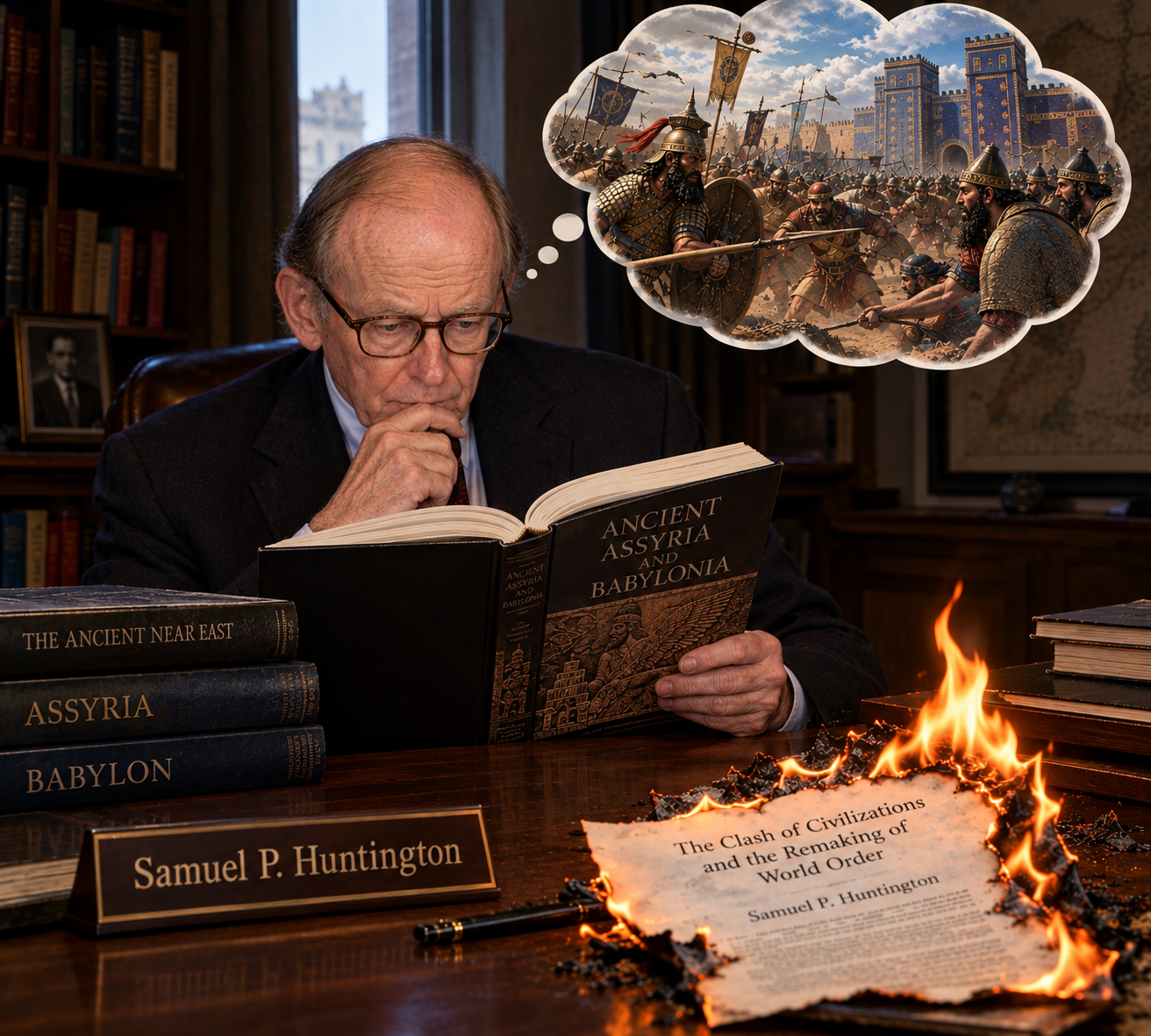
An image generated by ChatGPT that imagines the late Samuel Huntington reading about Assyro-Babylonian relations while his "Clash of Civilizations" thesis literally burns in front of him.
Clashing with the Clash of Civilizations: Assyria & Babylonia as a Case Study
By Daniel Silverman
Completed writing on September 25, 2026
Preface
The following blog post is an essay that I submitted as one of two seminar papers in order to complete the graduation requirements for the Bible and Ancient Near East M.A. program offered by the Rothberg International School of the Hebrew University of Jerusalem. This essay is the second seminar paper I wrote, and the first one can be read here.
The essay is quite long, so as a TL;DR, here is a short summary that encapsulates the general gist of what I wrote:
This paper tests the historical claim that Samuel Huntington made in his 1993 “Clash of Civilizations?” essay. Specifically, its uses Assyro-Babylonian history to shed skepticism over Huntington's assertion that the worst conflicts happen between civilizations and that members of the same civilization support each other during moments of inter-civilizational conflict. This paper draws upon the work of Assyriologists like Mordechai Cogan and Eckart Frahm to argue that, according to Huntington’s own criteria, Ancient Assyria and Babylonia belonged to one Mesopotamian civilization since they shared a common language and notably overlapped in regards to culture, religion, and politics. Nevertheless, the Babylonians ultimately allied with the Medes to destroy the Neo-Assyrian Empire. Consequently, this paper concludes that Huntington’s thesis fails as a a reliable guide for understanding history.
For those who do read this entire text, I hope it proves to be entertaining if not thought-provoking.
- Daniel Silverman,
October 29, 2026
Introduction
As the title suggests, this paper will focus on the historical relationship between ancient Assyria and ancient Babylonia. However, before we turn to a discussion on classical history, we will begin by turning to a year that for many people under age 30 is just as ancient as antiquity: 1993.
Excited optimism captured much of the world in 1993. The Cold War had ended a little over a year prior, and with it the threat of thermonuclear war between two geopolitical superpowers. The Berlin Wall had fallen, and most of Eastern Europe, including even the Russian Federation, seemed poised to adopt liberal democracy. America and its allies had won a quick and spectacular victory over Saddam Hussein’s Iraq, and in doing so the Americans gestured to the world that, with their preeminent economy and military, they could and would prevent any future acts of international aggression. In the flurry of enthusiasm that swept much of the world in the dawn of the global Pax Americana, a stream of new political ideas with sensationalist titles entered the public debate. Amongst these was an argument put forth in 1992 by Francis Fukuyama in his book titled The End of History and the Last Man (based on an essay he wrote in 1989) that declared that liberal democracy was the final political development for humanity.
In 1993, Fukuyama’s mentor at Harvard, Samuel Huntington, published an essay titled “The Clash of Civilizations?” as a sharp rebuttal to his former student. Whereas Fukuyama rosily predicted the unfettered adoption of liberal democracy by all of humanity over time, Huntington cast a far gloomier prognosis. In his belief, the end of the Cold War simply marked the end of ideology as the primary source of geopolitical conflict and the return to conflict between civilizations.
What makes Huntington’s work markedly different from Fukuyama’s thesis lies not just in its forecast, but importantly in its reliance on history as a guide for the future. Much of the Clash of Civilizations hypothesis depends on a specific interpretation of broader human history. Rather than a transition into an entirely new state of human affairs, Huntington argued that the world would reemerge into an era of civilizational clashes that had defined humanity up until the 17th century AD/CE (Huntington 1993).
This paper will not evaluate Huntington’s claims about world events since. Instead, this paper will judge Huntington’s claim that civilizational clashes characterize the default state of human conflict as evidenced by human history. It will do so by specifically using the example of Assyro-Babylonian history as a case study that contradicts Huntington’s thesis. In other words, this paper will challenge the accuracy of the historical assumption that the Clash of Civilizations thesis relies upon for its political forecasts.
While most of the historical examples Huntington uses to make his argument come from Medieval Europe and the Middle East, his claim about civilizations is inclusive of human history even before the Middle Ages. This paper thus finds it acceptable to challenge Huntington’s assertion with an analysis of Assyro-Babylonian relations even though Ancient Mesopotamia predates the Medieval Period by well over a millennium.
This paper’s focus will be on the similarities between Assyria and Babylonia, and how such commonalities failed to prevent catastrophic destruction of the former by the latter and thereby challenge the basic premises of Huntington’s Clash of Civilizations thesis. In order to do so, this paper will proceed in the following format.
In the first section, we will first conduct a brief overview of Huntington’s primary arguments, including how he defines civilization and civilizational conflict. Doing so will allow us to apply Huntington’s frameworks for our analysis of Assyria’s relationship with Babylonia. In the second section, we will utilize Huntington’s terminology to analyze the similarities that Assyria shared with Babylonia, notably in language, culture, religion, and self-identity. This section will draw upon both primary and secondary sources to make the case that, according to Huntington’s argumentative layout, Assyria and Babylonia were two nodes of a larger Mesopotamian civilization rather than two neighboring and competing civilizations. The secondary sources will largely draw from various historical facts and observations compiled in Assyria: The Rise and Fall of the World's First Empire by Eckart Frahm. The primary source material will consist of both Assyrian and Babylonian texts, most of which derive from the translations made by Mordechai Cogan in his books The Raging Torrent: Historical Inscriptions from Assyria and Babylonia Relating to Ancient Israel and Bound for Exile: Israelites and Judeans Under Imperial Yoke: Documents from Assyria and Babylonia. The third section will build upon the second by detailing how the Babylonian forces were primarily responsible for Assyria’s wholesale destruction, which presents a compelling case where intra-civilizational conflict proved more disastrous than inter-civilizational conflict and significantly consequential for world history. This paper will then end in a conclusion that summarizes its findings.
Ultimately, this paper does not attempt to conduct an exhaustive investigation into the cultural, political, and religious ties between Assyria and Babylonia. Instead, it hopes to organize established facts about both ancient cultures under the framework that Huntington established in his 1993 essay.
This paper will therefore cast doubt on a political science hypothesis by analyzing an important historical case study. By doing so, this paper not only hopes to challenge a highly controversial political thesis, but also seeks to demonstrate how the history of ancient Mesopotamia and classical studies in general can be applied for interdisciplinary purposes.

An image generated by ChatGPT that tries to sum up Huntington's "Clash of Civilizations" argument in a single scene.
Section 1: Huntington's Argument
Given the nuances of Huntington’s 1993 essay, we must first cover the basic premises of his thinking and his approach to the concept of civilization.
In regards to his notion of civilization clash, Huntington provides a clear explanation of what he envisions in the very beginning of his essay:
It is my hypothesis that the fundamental source of conflict in this new world will not be primarily ideological or primarily economic. The great divisions among humankind and the dominating source of conflict will be cultural. Nation states will remain the most powerful actors in world affairs, but the principal conflicts of global politics will occur between nations and groups of different civilizations. The clash of civilizations will dominate global politics. The fault lines between civilizations will be the battle lines of the future. (Huntington 1993)
However, what does he mean by “civilization”?
Huntington offers a fairly concise definition that his readers can readily absorb. In his words,
A civilization is a cultural entity… A civilization is thus the highest cultural grouping of people and the broadest level of cultural identity people have short of that which distinguishes humans from other species. It is defined both by common objective elements, such as language, history, religion, customs, institutions and by the subjective self-identification of people. (Huntington 1993)
Importantly, Huntington contrasts his concept of civilization from other important social groupings, such as village, regional, ethnic, and national identities. He uses the example of a native of Rome as potentially having multiple layers of identity, such as being an Italian, a Catholic, and a European (Huntington 1993). However, civilizational identity for Huntington is the ultimate sense of social belonging that engulfs all other forms of socio-cultural grouping. As he puts it,
The civilization to which he belongs is the broadest level of identification with which he intensely identifies. (Huntington 1993)
This will prove important for our coming analysis of Assyria and Babylonia, as for Huntington civilizational identity does not contrast with political loyalties to a certain city, deity, or king. Civilizational identity instead looms larger than all other social, political, and religious markers.
The most contentious portion of Huntington’s thesis does not lie in his portrayal of civilizational identity, but in two other claims. First, he emphasizes the intrinsic incompatibility of civilizations with each other. Civilizations, in his belief, do not simply exist side by side, but are distinctly defined by inherently unique cultural and religious influences.
First, differences among civilizations are not only real; they are basic. Civilizations are differentiated from each other by history, language, culture, tradition and, most important, religion. The people of different civilizations have different views on the relations between God and man, the individual and the group, the citizen and the state, parents and children, husband and wife, as well as differing views of the relative importance of rights and responsibilities, liberty and authority, equality and hierarchy. These differences are the product of centuries. They will not soon disappear. They are far more fundamental than differences among political ideologies and political regimes. (Huntington 1993)
Thus, the factors that unite the peoples within civilizations in turn distinguish civilizations from one another.
Moreover, Huntington believes that civilizational identity is the root-cause for the most violent and profound human conflicts in history. While he admits that civilizational differences do not automatically guarantee devastating conflicts between civilizations, he argues that,
Over the centuries, however, differences among civilizations have generated the most prolonged and the most violent conflicts…The interactions among peoples of different civilizations enhance the civilization- consciousness of people that, in turn, invigorates differences and animosities stretching or thought to stretch back deep into history. (Huntington 1993)
This is the crux of his Clash of Civilizations idea. Whereas the majority of human conflict since the Peace of Westphalia (at least in Europe and North America) was driven by rivalries among monarchs, nation-states, and ideologies, Huntington explains to his readers that this period of history was an aberration from the primal state of affairs.
These conflicts between princes, nation states and ideologies were primarily conflicts within Western civilization...With the end of the Cold War, international politics moves out of its Western phase, and its center- piece becomes the interaction between the West and non-Western civilizations and among non-Western civilizations. (Huntington 1993)
Notably, the move out of the “Western phase” is not a shift to an entirely new state of human affairs. For Huntington, the interaction and coming violence between civilizations will mirror how history always existed before the emergence of European nation-states. In particular, he turns to the Medieval conflicts between Christians and Muslims. For example, he writes that,
Conflict along the fault line between Western and Islamic civilizations has been going on for 1,300 years. (Huntington 1993)
Similarly, he distinguishes Eastern Europe from Western Europe based on the confessional differences between Catholicism and Eastern Orthodoxy during the Middle Ages (Huntington 1993). His argument is not confined to a resumption of Medieval affairs, however. The civilizational warfare, in his eyes, is the natural apex state of human political conduct.
Westerners tend to think of nation states as the principal actors in global affairs. They have been that, however, for only a few centuries. The broader reaches of human history have been the history of civilizations. In A Study of History, Arnold Toynbee identified 21 major civilizations; only six of them exist in the contemporary world. (Huntington 1993)
For Huntington, wars between civilizations are the apex form of human conflict since the dawn of time that were only interrupted in roughly the last 350 years. Huntington writes that the core characteristics that make up civilizational identity, particularly religion, are immutable in comparison to political loyalties and economic ideologies and therefore conflicts based on civilizational differences will be harder to defuse than those of the recent past (Huntington 1993).
Lastly, Huntington posits that peoples within a civilization are unlikely to enact devastating destruction upon each other. In what he refers to as the “kin-country syndrome,” countries that share a common civilizational backdrop will naturally gravitate to support rather than violently confront each other (Huntington 1993).
Groups or states belonging to one civilization that become involved in war with people from a different civilization naturally try to rally support from other members of their own civilization… A world of clashing civilizations, however, is inevitably a world of double standards: people apply one standard to their kin- countries and a different standard to others. (Huntington 1993)
According to Huntington’s logic and his interpretation of history, not only are members of a common civilization unlikely to destroy each other, but, because civilizational conflict is an ancient phenomenon, there should be no historical instance of such annihilation either.
As this paper will demonstrate, such an assumption is unfounded. We will now turn our attention to ancient Mesopotamia.
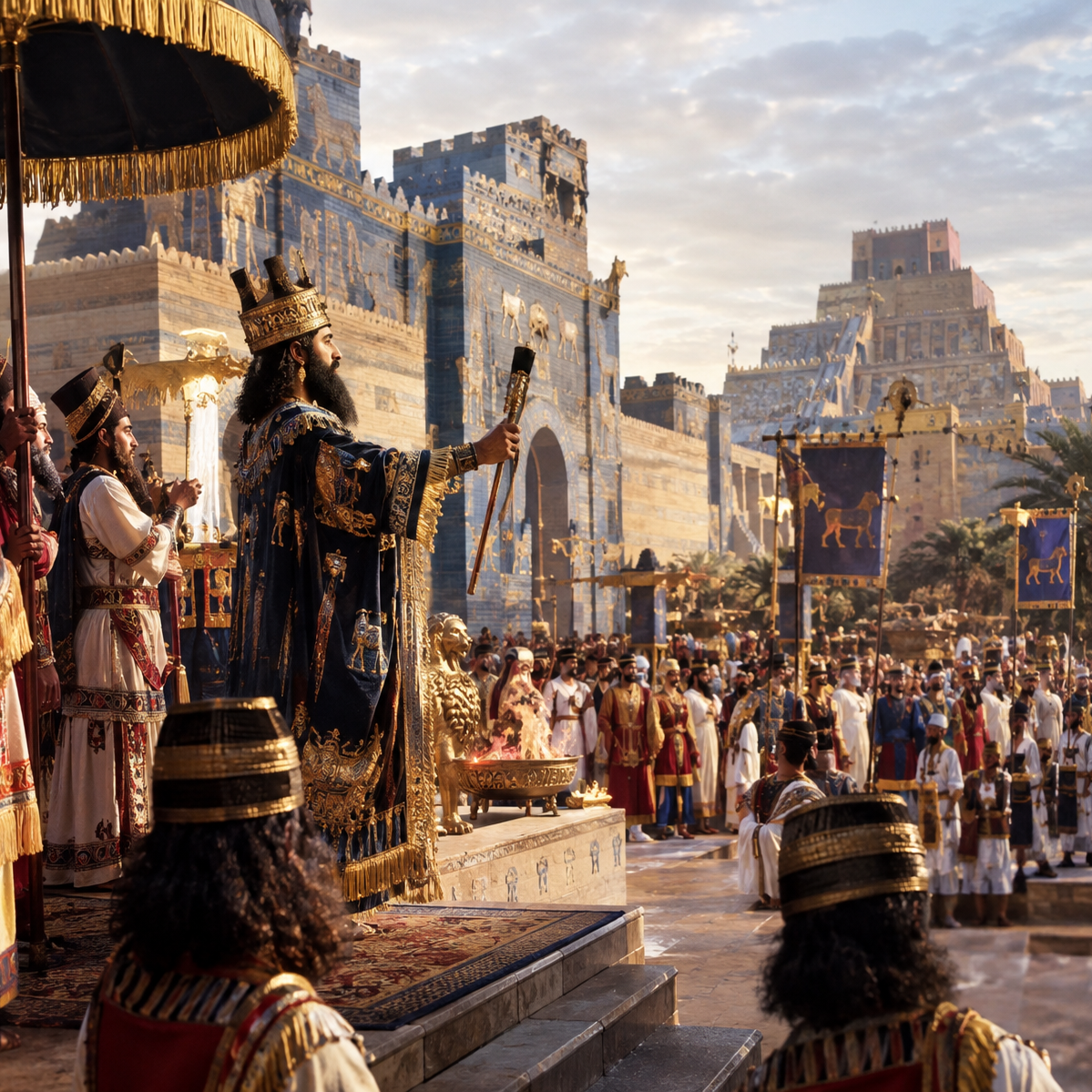
An image generated by ChatGPT that imagines an Assyria king helping conduct the Akitu festival in Ancient Babylonia.
Section 2: Assyro-Babylonian Civilization
Based on the definitions of civilization that Huntington laid out, we can claim that Assyria and Babylonia constituted two nodes of a common civilization in Mesopotamia. Whether or not the ancient Assyrians or Babylonians actually conceptualized a term comparable to Huntington’s view of civilization and applied it to themselves is not necessary for us to confront the Clash of Civilizations hypothesis. As this section will demonstrate, the Assyrians and Babylonians most definitely shared important commonalities in language, culture, tradition, religion, and, to some extent, self-identity.
Language
We will start with language as it is the quickest factor to make a conclusion about. It is a well-known fact in Assyriology that the Assyrians and Babylonians both spoke Akkadian (albeit in different dialects) and used cuneiform for their writings. As Frahm puts it,
Assyria and Babylonia have been described, somewhat like Scotland and England or England and America, as “two countries divided by a common language.”(Frahm 2023, 72)
That said, it is worth noting that the Assyrians adopted many linguistic traditions from the Babylonians. For example, during the Middle and Neo-Assyrian Periods, royal scribes in Assyria wrote cuneiform texts according to Babylonian standards (Frahm 2023, 95). Additionally, as Frahm explains in his mention of Barbara N. Porter’s work, some of the high-ranking Babylonians that Esarhaddon deported to Nineveh after his military campaigns in Babylonia in 675 BC/BCE[1] were forced to copy cuneiform texts for the Assyrians (Frahm 2023, 255). Even some of the Assyrian kings who fought against the Babylonians adapted their royal writings to match Babylonian styles (Frahm 2023, 215).
Sargon tried to be as Babylonian as he could, even if this meant that he had to model some of his inscriptions on those of his Babylonian arch-enemy Marduk-aplu-iddina. (Frahm 2023, 215)
We can confidently say that the Assyrians, in addition to speaking Akkadian, frequently incorporated Babylonian cuneiform styles into their culture and governance at the highest levels of power. Far from being coincidental speakers of the same language as their southern neighbors, the Assyrians clearly saw the dialect of the Babylonians as something valuable to include in their own identity.
Culture and Tradition
Yet language was far from all that Assyria had in common. Unlike the customs of other conquered peoples that the Assyrians absorbed into their empire, Babylonian cultural and religious norms were given a level of respect within Assyria that is best explained by Huntington’s kin-country syndrome.
On one hand, the Assyrians, particularly the elites, did not seem to have any objection to adopting foreign art and technology, as evidenced by reliefs in the Northwest Palace of Calah from Ashurnasirpal II’s rule that seem to have borrowed motifs and artistry from the Neo-Hittite and Aramaean city-states of northern Syria, such as Carchemish (Frahm 2023, 99).
On the other hand, Babylonia was unmatched in its early and consistent cultural and religious influence on its northern neighbor. In Frahm’s words,
Assyrian encounters with Babylonia in the south led to a pronounced Babylonization of Assyrian culture and marked the beginning of a strong political rivalry that would characterize the relationship between the two neighbors for centuries to come. (Frahm 2023, 57)
Importantly, much of the drives to adopt Babylonian cultural and religious norms originated from Assyria’s rulers. For example, Ashur-uballit I promoted Babylonian religion and scholarly culture to the extent that he created a cult for Marduk, the patron god of the city of Babylon, in Assyria’s contemporary capital of Ashur and appointed a Babylonian priest as his chief scribe (Frahm 2023, 62).
The inclusion of Babylonian culture into Assyrian life was not just a top-down affair. In addition to copying Babylonian literary and scholarly tablets that Assyrian kings like Tukulti-Ninurta I brought back with them after military campaigns against Babylonia, Assyrian scribes copied lexical lists of Sumero-Akkadian cuneiform brought from Babylonia for scholarly pursuits in Assyria (Frahm 2023, 80). On an even more practical level, Assyrian physicians relied on tablets with medical advice that were originally composed by famous Babylonian counterparts, such as a certain Rabasha-Marduk (Frahm 2023, 81). By the time of Tiglath-pileser I’s reign, Assyrians had even abandoned the traditional Assyrian month names in favor of Babylonian ones (Frahm 2023, 92–93). The widespread diffusion of Babylonian culture on both the macrolevel by the Assyrian ruling class and on the microlevel by ordinary Assyrians for daily life suggests a cultural intimacy between Assyria and Babylonia beyond occasional influence and artistic borrowing.
Even if we were to surmise that the Assyrians had a wholly distinct cultural identity from the Babylonians prior to the Middle Assyrian Period, years of adopting and borrowing from Babylonia essentially molded Assyria in the civilizational image of Babylonia. The notion of Assyrians becoming culturally comparable to the Babylonians over time is not out of line with Huntington’s ideas. According to Huntington,
Civilizations obviously blend and overlap, and may include subcivilizations… Civilizations are dynamic; they rise and fall; they divide and merge. (Huntington 1993)
By Huntington’s own admission, civilizations can broaden to include people previously outside of their identity. As former vassals of the Hurrians of the Mitanni Kingdom (Frahm 2023, 62), the Assyrians may not have been culturally close enough to the Babylonians at first to have been initially considered part of the same Mesopotamian civilization. However, even if this may not have been the case during the late Bronze Age, evidence from the Middle and Neo-Assyrian Periods illustrates that the Assyrians established bonds of cultural kinship with their southern neighbors over time. As Frahm cleverly puts it,
Playing on the famous line about Greece and Rome by Horace, one could say that, under Sargon, “captive Babylonia took captive her savage conqueror.” (Frahm 2023, 215)
Given Huntington’s emphasis on religion as an important factor in his thinking about civilizations, the shared religious customs between Assyria and Babylonia must be touched upon.
Importantly, we should note that the Assyrians and Babylonians embraced polytheistic faiths founded on a pantheon of deities. Thus, unlike the monotheistic religions that Huntington focuses on in his essay, matters of faith may not have been subject to scrutiny and exclusion in ancient Assyria and Babylonia in the same ways Huntington frames religion. Whereas Huntington describes the impossibility for one to be half-Catholic and half-Muslim (Huntington 1993), we have records of Assyrian kings worshipping both Assyrian and Babylonian deities.
Nevertheless, Huntington elevates religion as the most important factor for civilizational identity, which forces us to consider how the adoption of Babylonian religious customs by Assyrians would, in Huntington’s framework, therefore classify Assyria and Babylonia under a common civilizational boundary.
As mentioned above, at the very latest in Assyrian history, Ashur-uballit I initiated the introduction of Babylonian religion to the city of Ashur by creating a cult for Marduk. Yet, he was far from the last Assyrian king to promote Babylonian religion. In 812 BC/BCE, Shamshi-Adad V conducted sacrifices to the patron deities of Borsippa and Cutha, two Babylonian cities, while his army fought against the forces of Baba-aha-iddina, then king of Babylonia (Frahm 2023, 115). Reverence for Babylonian deities by Assyrian kings became so regular that in some cases the elevation of Assyrian deities over their Babylonian counterparts was considered a reason for divine wrath.
In a text that scholars refer to as “The Sin of Sargon,” Sennacherib hints how his father, Sargon, may have died as a result of decreasing attention to the Babylonian deities in favor of traditional Assyrian gods (Oracc/SAAo n.d.). In lines 17 to 21 of the “The Sin of Sargon,” Sennacherib notes,
"Was it because [he esteemed] the gods o[f Assyria too much], [placing them] above the gods of Babylonia [......, (and was it) because] he did no[t keep] the treaty of the king of gods, [that Sargon my father] was slain [in the enemy country and] was not b[uried] in his house?" (Oracc/SAAo n.d.)
The “Sin of Sargon” text reveals how important the worship of Babylonian deities had become for royal religious duties, to the extent that any king that strayed away from proper respect to the Babylonian gods would be subject to unfavorable consequences.
Yet Sargon II was far from the only Assyrian king who incorporated Babylonian culture and religion into his court. Until Sennacherib, many Assyrian kings championed the famous Babylonian Akitu Festivals held on behalf of Marduk, the primary god of Babylon (Frahm 2023, 225–26). For example, Tiglath-pileser III and Sargon II both directly participated in the Akitu Festivals in Babylon during their reigns (Frahm 2023, 214–15). Clearly, many of the Assyrian kings saw Babylonian religion as central to their faith.
Even Sennacherib, despite his contempt for Babylonia, showcased some interest in Babylonian religion when we consider the literary allusions to the Enūma Eliš, the Babylonian creation epic, that his scribes made when writing an account of Sennacherib’s claimed victory in the Battle of Halule (Frahm 2023, 227). The following text from a royal inscription about Sennacherib’s conduct at the Battle of Halule parallels Marduk’s preparation to fight Tiamat in Tablet IV of the Enūma Eliš:
I raged like a lion. I put on my corslet; my helmet, emblem of battle, I placed on my head; my excellent battle-chariot, which flattens the foe, I hastily mounted in my heart’s fury. The strong bow which Aššur gave me I seized in my hands; the arrow that cuts off lives I grasped in my palm. (Melammu Project n.d.)
In comparison, here are lines 35 – 40 of Tablet IV:
He made a bow, appointed it his weapon, He mounted an arrow, set it on the string. He took up a mace, held it in his right hand, Bow and quiver he slung at his side. Thunderbolts he set before his face, With raging fire he covered his body. (Electronic Babylonian Library n.d.)
Sennacherib’s allusions to the Enūma Eliš illustrates some fascination on his part with Babylonia’s religious traditions. In order to appreciate this example, consider how unlikely it would have been for Muslim writers to compose a poem for Saladin that made allusions to the New Testament or for Christian heralds to sing songs about Richard the Lionheart that borrowed ideas from the Quran.
Even when Sennacherib wanted to humiliate his Babylonian enemies after his conquest of Babylon, he often did so in repeated patterns of repurposing Babylonian religious artifacts for Assyrian usage that Eli Tadmor has referred to as “cultural cannibalism” (Frahm 2023, 227). For example, after Assyrian troops took the cultic bed of Marduk from the Esagil Temple in Babylon to the city of Ashur, Sennacherib rededicated the artifact to the Assyrian god Ashur (Frahm 2023, 227).
While Sennacherib may have had a complicated relationship with Babylonian religion, his son and successor, Esarhaddon, had no qualms with embracing and praying to Babylonian entities.
In an inscription composed in 673 BC/BCE, Esarhaddon announces how he not only worships Ashur and other traditional Assyrian deities, but also seeks counsel and comfort from Marduk.
I thought and considered (the matter), as follows: “Their ways are insolent and they trust (only) their own judgment. What will they (not) do against the will of gods?” To Ashur, king of the gods (and) merciful Marduk, for whom malice is an abomination, with blessings, supplications, and gestures of humility, I prayed, and they accepted my words. (Cogan 2015, 152)
Even more telling is the invocation of various Babylonian deities in the adê treaty that Esarhaddon prepared in 672 BC/BCE to ensure that his sons Ashurbanipal and Shamash-shum-ukin would ascend the thrones of Assyria and Babylonia, respectively. In the opening to the treaty text, Esarhaddon calls upon various deities to serve as divine witnesses for his adê.
Esarhaddon, king of Assyria, on whose behalf he has concluded this adê with you, (which) he enforced, made and concluded in the presence of Jupiter, Venus, Saturn, Mercury, Mars and Sirius; in the presence of Ashur, Anu, Enl[il], Ea, Sin, Shamash, Adad, Marduk, Nabu, Nusku, Urash, Nergal, Mullissu, Serua, Belet-ili, Ishtar of Nineveh, Ishtar of Arba’il, the gods dwelling in heaven and earth, the gods of Assyria, the gods of Sumer and Akkad, all the gods of the lands. (Cogan 2013, 61)
As the text clearly states, Esarhaddon draws upon reverence for Babylonian deities, such as Marduk and Nabu, in addition to important gods from Assyrian tradition. Moreover, he specifically mentions how he relies on the gods of Assyria and “Sumer and Akkad” (a traditional term for Babylonia), in addition to several astral bodies, as witnesses for his treaty and not the deities of other peoples in Assyria’s realm. He does not, for example, call upon YHWH of the Kingdom of Judah as a witness for his treaty.
Archaeologists discovered copies of Esarhaddon’s adê treaty in both the Nabu Temple complex in Calah and Tell Tayinat by the Orontes River, which signals that Assyrian authorities circulated copies of the text throughout the Assyrian Empire to demand fealty from both Assyrian elites and vassal kings (Cogan 2013, 56–57). From this, we can interpret that, far from being a private matter, the Assyrian kings wanted all the citizens of their realm to know that they worshipped both Assyrian and Babylonian deities. In other words, the official pantheon of the Assyrian Empire consisted of both Assyrian and Babylonian deities, which means that the Assyrian religion was intricately connected with the Babylonian one.
The adoption of foreign gods and religious traditions may not have been as controversial for the members of polytheistic faiths as it is for followers of monotheistic religions today. The Assyrians had a regular practice of taking the images of gods from a variety of enemies, such as the Babylonians and the Elamites, back to Assyria during their military campaigns (Cogan 2015, 221–23), which invites us to consider that the Assyrian religion may not have been nearly as exclusive as modern monotheistic religions.
This said, if Huntington believed that religion proved critical for defining civilizational identity, then both Assyria and Babylonia would have been part of the same civilization.
Self-Identity
As mentioned earlier, the Assyrians and Babylonians may not have had a concept of civilization in the same way that Huntington did. Even if they did, they may not have applied it to themselves.
However, we do have some indication that the Assyrian elites did see themselves as sharing a similar political destiny with their Babylonian neighbors in a way they did not with the other peoples they conquered.
For one, Babylon and other traditional Babylonian temple cities, such as Borsippa and Uruk, were not subject to the same taxes and corvée duties that other conquered cities in the Assyrian Empire were obliged to perform (Frahm 2023, 215). The Babylonians enjoyed preferential treatment by the Assyrians that other subjugated nations, such as the Phoenicians, Israelites, and Judahites, never received, which provides further strong evidence that kin-country syndrome existed in Assyria’s attitude towards Babylonia.
More importantly, many of the Assyrian kings assumed a personal connection with Babylonia that differed from the other non-Assyrian lands they conquered or inherited.
[I]n 729 BCE, when Tiglath-pileser III conquered the city of Babylon, Babylonia finally became an integral part of Assyria’s political identity. Right away, Tiglath-pileser began to call himself, in addition to his Assyrian titles, “King of Babylon” and “King of Sumer and Akkad” (the traditional names for Babylonia’s southern and northern parts, respectively). He thus formed what one could call in constitutional terms a “personal union” between Assyria and Babylonia. Other places occupied by Assyrian armies – for example, Arpad or Damascus – were simply annexed, without the Assyrian monarch taking on the titles of their previous rulers. But Tiglath-pileser was eager to communicate that Babylon, with its age-old cuneiform culture and familiar religious institutions, was different. (Frahm 2023, 214)
The incorporation of Babylonia as a core part of Assyria’s political identity continued beyond Tiglath-pileser III. Sennacherib installed his firstborn son, Ashur-nadin-shumi, as king of Babylon in 700 BC/BCE, and it is only after discontent Babylonians delivered Ashur-nadin-shumi to the Kingdom of Elam (where he later died) that Sennacherib unleashed his rage against Babylonia (Frahm 2023, 217–19).
However, despite the calamity that befell his brother, Ashur-nadin-shumi, Esarhaddon later installed one of his own sons, Shamash-shum-ukin, as king of Babylonia. In fact, the adê treaty that Esarhaddon wrote in 672 BC/BCE was provisioned for both Ashurbanipal and Shamash-shum-ukin.
If Esarhaddon, king of Assyria, goes to his fate while his sons are minors, you shall help Ashurbanipal, the great crown prince, take the throne of Assyria (and) you will help Shamash-shum-ukin, his equal brother, the crown prince of Babylon, to ascend the throne of Babylon. You will entrust him with the kingship over all of Sumer, Akkad and Karduniash (i.e., Babylonia). He will take with him the gifts that Esarhaddon, king of Assyria, his father, gave him; do not hold back even one. (Cogan 2013, 63–64)
Ashurbanipal and Shamash-shum-ukin are the only sons of Esarhaddon mentioned in this adê treaty, and no other territories beyond the lands traditionally ascribed to Babylonia are given to the latter. Clearly, Babylonia held a position of respect by the Assyrians so much so that Assyrian princes could assume direct kingship over it.
Moreover, the above text notes that Shamash-shum-ukin is an “equal brother” to Ashurbanipal. If Shamash-shum-ukin was considered equal to Ashurbanipal, it follows that Babylonia, despite possessing far smaller territory than the entirety of the Assyrian Empire, also occupied a position of equality with Assyria in the eyes of Esarhaddon. This indication is further reinforced by the artwork found on the Zenjirli Stela of Esarhaddon from 671 BC/BCE, currently housed in the Pergamon Museum in Berlin.
[1]Stylistic note: I combine both traditional and more modern academic standards for year phrasing for idiosyncratic purposes, so that specific year dates read “BC/BCE” and “AD/CE” rather than one or the other.

Figure 1, Photo of the Zenjirli Stela of Esarhaddon taken by Albert Schramm in 1925 (Schramm 1925). A link for the photo can be found here.
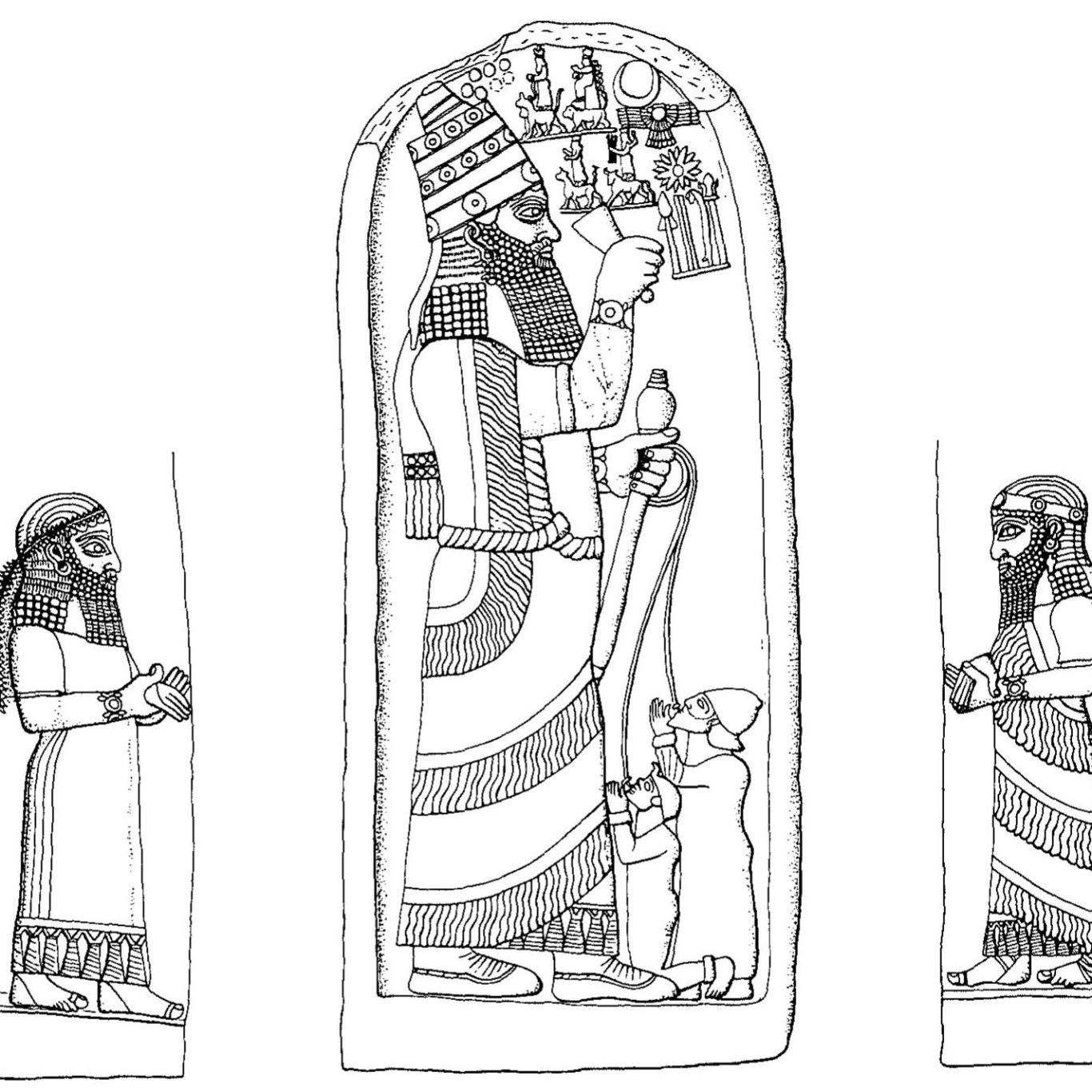
Figure 2, An artist’s rendering of the Zenjirli Stela of Esarhaddon (Frame 1992). A link for the image can be found here.
The imagery on the Zenjirli Stela of Esarhaddon as shown in Figures 1 and 2 depicts an exaggerated Esarhaddon towering over the crown prince of the 25th dynasty of Egypt (the Nubian dynasty) and an unnamed ruler, possibly a Phoenician king of a city-state like Sidon or Tyre, after his successful campaign against Taharqa in Egypt in 671 BC/BCE (Staatliche Museen zu Berlin n.d.). Additionally, on the right flank of the stela is an image of Ashurbanipal dressed as an Assyrian prince, whereas the left flank showcases Shamash-shum-ukin adorned in Babylonian clothing and headwear (Frame 1992).
This stela, together with the text of the adê treaty, sufficiently demonstrates that Esarhaddon saw Babylonia aligned with Assyria more than any of the other peoples and lands he controlled. Not only did Esarhaddon elevate Babylonia in importance by assigning one of his sons as crown prince, but even official artistry glamorizing Esarhaddon’s military victories includes depictions of Shamash-shum-ukin in Babylonian style.
Clearly, different Assyrian kings during the Neo-Assyrian Period identified strongly enough with Babylonia that they granted its temple cities unique administrative exemptions and had either themselves or one of their sons assume direct rule over Babylon. The unique status that Babylonia enjoyed under different Assyrian kings (with the notable exceptions of Sennacherib and Ashurbanipal) during its time under Assyrian imperial influence illuminates the degree of self-identification that members of the Assyrian ruling elite, if not the Assyrian population in general, had with Babylonia. Even without the shared linguistic, cultural, and religious commonalities, this pattern by Assyrian rulers of exceptional treatment towards and personal identification with Babylonia would be enough to classify the Assyro-Babylonian relationship as one of kin-country syndrome according to Huntington’s thinking.
Acknowledging Counter-Arguments
While a plethora of evidence has been submitted to demonstrate how the Assyrians and Babylonians could plausibly be categorized as members of a common civilization per Huntington’s understanding, we should take time to briefly acknowledge some potential weaknesses with the framework.
As mentioned before, it is not clear that either the Assyrians or Babylonians ever had their own version of Huntington’s concept of civilization. Even if they did and even if the Assyrians saw the Babylonians as civilizational cousins, we cannot assume that the Babylonians necessarily felt the same way towards the Assyrians. It is worth noting that, despite the privileges that Babylonian temple cities enjoyed under Assyrian auspices, the Babylonians had a consistent pattern of rebelling against the Assyrians (Frahm 2023, 214).
Moreover, cultural and religious differences existed between Assyria and Babylonia. For example, during Sennacherib’s reign, scribes rewrote the Enūma Eliš so that it recounted a victory of Ashur, not Marduk, over Tiamat (Frahm 2023, 230). Even in the case of Esarhaddon’s adê treaty, one could argue that Babylonia was bequeathed to Shamash-shum-ukin as a consolation prize given that Esarhaddon chose one of his younger sons, Ashurbanipal, as crown prince of Assyria over him (Frahm 2023, 280).
Some Assyriologists may hesitate in classifying Assyria and Babylonia as belonging to the same civilization. Frahm, for example, has characterized Assyria and Babylonia as “sister civilizations.”
The conflict between Ashurbanipal and Shamash-shum-ukin, the king of Babylon, was emotionally charged like no other war in Assyrian history. The two royal antagonists were siblings, and the two polities involved, Assyria and Babylonia, were sister civilizations that shared many cultural and religious traditions. (Frahm 2023, 280)
This all said, for the purposes of using Assyro-Babylonian history as a case study against Huntington’s thesis, the above criticisms are not fatal for this paper.
First, Huntington’s thesis does not preclude internal conflict within civilizations. Huntington introduces the concept of kin-country syndrome to distinguish how some nations give preferential treatment to each other over others; he never denies that cultural and religious differences exist within a civilization. For example, he groups Catholic and Protestant countries in Europe as part of a common Western civilization (Huntington 1993). Furthermore, Huntington never denies that conflicts occur within civilizations. For instance, Huntington classifies Western Christianity and Islam as two distinct civilizations, despite the fact that vicious and bloody wars occurred within Christian Europe and the Muslim Middle East during the Middle Ages. The Clash of Civilizations explains that the wars between civilizations were the most consequential and devastating conflicts in human history in comparison with other wars (Huntington 1993). Huntington would likely dismiss the Babylonian rebellions as no more damning to his thesis than the Medieval wars between the English and the French.
Second, Huntington’s classification is meant to categorize countries and nations according to immutable social characteristics. Active self-identification is one of his factors, but the others – history, language, culture, tradition and religion – do not necessarily depend on peoples possessing consciousness of their relationship with other societies. In other words, Huntington’s definition classifies countries and nations whether or not rivalries and ill-will existed between various city-states, empires, kingdoms, and principalities.
Lastly, this paper does not seek to present an objective understanding of “civilization.” While there are Assyriologists, such as Morris Jastrow Jr. (Jastrow Jr. 1915), who did classify Assyria and Babylonia as a singular civilization, the purposes of this paper do not depend on navigating through the opinions of different Assyriologists. Assyria and Babylonia are used here as a case study against Huntington, and so long as the two countries fit his civilizational terminology, then Assyro-Babylonian history can be employed against his thesis.
Having sufficiently concluded that Assyria and Babylonia would be defined as members of a common Mesopotamian civilization according to Huntington’s logic, we can now proceed to discuss why the example of Assyro-Babylonian history undermines the Clash of Civilizations thesis.
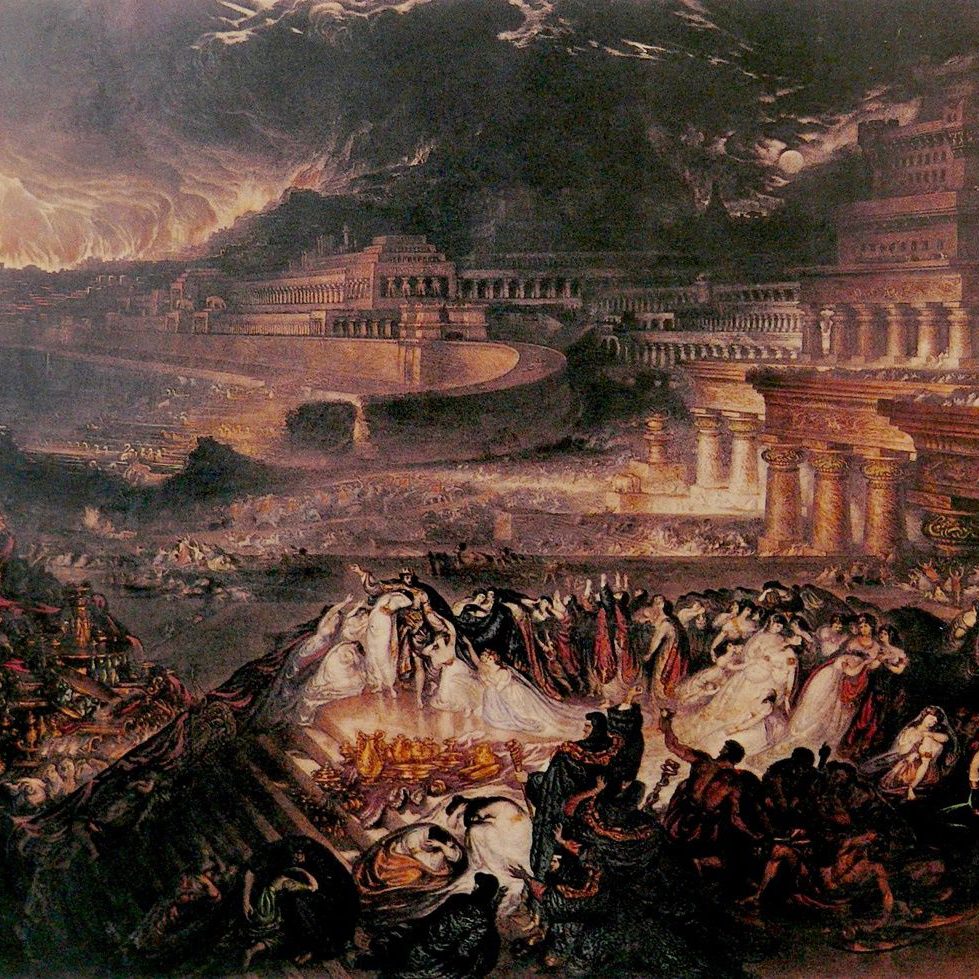
John Martin's 1829 "The Fall of Nineveh" painting. A link for the painting can be found here.
Section 3: Clashing with the Clash of Civilizations Thesis
The absolute destruction of the Assyrian realm has been told in various stories by different peoples throughout the centuries. The Book of Nahum in the Hebrew Bible tells of the sack of Nineveh in the form of a prophecy (although most Bible scholars would date the text to after 612 BC/BCE (Frahm 2023, 392)). Greek historians, such as Herodotus and Diodorus Siculus, wrote about the fall of Assyria (Frahm 2023, 402). We even have a cuneiform text from the Seleucid Empire known as the Nabopolassar Epic that provides an account of Assyria’s fall (Frahm 2023, 325). The discovery and eventual translation of the Babylonian Chronicles finally gave primary source weight to the writings of non-Mesopotamian origin, and a team from the University of California, Berkeley that worked at the archaeological site of Nineveh in 1989 and 1990 ultimately helped to deliver physical evidence that contextualized the utter devastation that befell the capital city of Assyria in 612 BC/BCE (Frahm 2023, 323). For our purposes, what proves most interesting is not the brutal fate that befell Nineveh, Ashur, and other Assyrian cities, but that it was the Babylonians who devastated them.
As mentioned previously, wars did occur frequently between Assyria and Babylon throughout Assyro-Babylonian history. To reiterate, Assyrian kings such as Tiglath-pileser III, Sennacherib, and Ashurbanipal all conducted military campaigns in Babylonia to either conquer the territory or subdue rebellions against Assyria’s rule. Yet, as also noted before, the wars between Assyria and Babylonia do not necessarily negate the idea that both polities should be considered members of the same civilization per Huntington’s definition. If Huntington’s core premises are that members of a common civilization appeal to each other for help when in conflict with other civilizations (kin-country syndrome) and that the most violent and profound historical conflicts prior to the modern era occurred between civilizations, then most of the Assyro-Babylonian wars would not be particularly relevant for undermining the Clash of Civilizations thesis (Huntington 1993).
Yet, this is what makes the case of Assyria and Babylonia so damning for Huntington’s argument, because the Babylonians allied with a foreign people in order to totally annihilate the Assyrians, and in doing so completely altered the path of world history.
Rather than providing an account of the final years of Assyria and the sudden collapse of its empire, this section will instead briefly note the details of interest that help underscore how the example of Assyro-Babylonian history weakens the Clash of Civilizations thesis. In particular, this section will draw from primary source material that outlines how dedicated the Babylonians were in their mission to eradicate the Assyrian Empire.
First, Huntington’s kin-country syndrome falls apart when we observe the last decade of the Assyrian Empire’s existence. The kin-country syndrome predicts that members of the same civilization, despite whatever rivalries exist between them, will inevitably rally together when faced with threats from peoples of another civilization. Not only did the Babylonians under Nabopolassar engage in a bitter war with the Assyrians in the 610s BC/BCE, but, starting in 614, they also allied with the Medes to do so (Frahm 2023, 332–33). That the Medes were an Iranian people who still embraced elements of a nomadic lifestyle (Frahm 2023, 331), and thus linguistically, culturally, and religiously far more different from Babylonia than Assyria, seemed to make no difference to Nabopolassar and the wider Babylonian population. Consider the following text from the Babylonian Chronicles for the regnal years of Nabopolassar:
Year 12. In the month Ab, the Medes, when they xxx [] against Nineveh, [] x hurried and they captured Tarbisu, a city in the district of Nineveh x []. He proceeded along [the Tig]ris and encamped against Ashur. He attacked the city and [] [] destroyed. He inflicted a terrible defeat on a large number of people; he took captives (and) [carried off its sp]oil. [The king of A]kkad and his tr[oops], who had marched to the aid of the Medes, did not reach the battle (intime); the ci[ty x[] [The king of Akk]ad and C[yax]eres met one another by the city and concluded a treaty of peace and good will between them. (Cogan 2015, 227)
[Year 14] The king of Akkad mobilized his troops [and marched to]. C[y]axe[res], king of the Umman-manda, towards the king of Akkad [marched?] xxx […] and they met one another. The king of Akkad [Cy]axeres [] brought across and they marched along the bank of the Tigris. [They encamp]ed against Nineveh… The month Ab, [day x], they inflicted a great [defeat] on a large of people. On that day, Sin-shar-ishkun, king of Assyr[ia,] x []x They carried off the rich spoil of the city and the temple, (and) [turned] the city into a ruin heap. []. (Cogan 2015, 228).
The fact that the Babylonians destroyed the capital city of their civilizational cousins in Assyria would be difficult for the Clash of Civilizations to explain. That they did so in tandem with a foreign people well outside the confines of Mesopotamia shatters the logic of Huntington’s kin-country syndrome.
In fact, the Babylonians were not the only culprit to break the stipulations of the kin-country syndrome. The Assyrians, desperate to survive the onslaught of the Babylonians and Medes, allied with the Manneans (Frahm 2023, 339) and Egyptians (Cogan 2015, 224).
Year 10... The month Ab, day 12, he attacked the troops of Assyria and the troops of Assyria retreated before him. He inflicted a major defeat on Assyria (and) took many of them captive. The Manneans, who had come to their (the Assyrians) aid and the officers of Assyria, he captured. (Cogan 2015, 226)
The Assyro-Babylonian War of the 610s resulted in the total extermination of Assyria as an independent and functioning polity, as a Babylonian and Median force took Harran, the last major Assyrian stronghold, in 610 BC/BCE (Frahm 2023, 337). Ashur-uballit II, the last Assyrian king, tried to retake the city with Egyptian troops in 609 BC/BCE, and his failure to do so marked the final political act of the Assyrian Empire; Ashur-uballit disappeared from the written records after this defeat (Frahm 2023, 337–38).
<Year 17.>... In the month Tammuz, Ashur-uballit, king of Assyria, a large Egyptian force [] crossed the River (Euphrates) and marched to conquer Harran. [] They defeated the garrison, which the king of Akkad had stationed within it. When they defeated it, they encamped against Harran. Until the month of Elul, they attacked the city without success. (Cogan 2015, 229)
An alleged letter composed in 612 BC/BCE by Nabopolassar to Sin-sharru-ishkun, the king of Assyria at the time, before the fall of Nineveh gives hints as to the genocidal intent that the Babylonians had for the Assyrians.
I shall avenge Babylon. I shall pile up (the debris of) the wall of Nineveh, which is made of strong stone, like a mound of sand; I shall uproot (the seed of) Sennacherib, son of Sargon, the offspring of a house-slave, conqueror of Babylon, plunderer of the land of Babylonia. Because of the evil deeds that you committed against the land of Babylonia. (Frahm 2023, 334)
The text of this letter seems to have been copied by scribes in Babylon centuries after the conquest of Nineveh, and thus cannot be fully relied upon as a wholly accurate account (Frahm 2023, 334). Nonetheless, Frahm writes that the scribes studied correspondences between Nabopolassar and Sin-sharru-ishkun, and hence the general sentiments of this text could reflect the truth (Frahm 2023, 334). If so, this would demonstrate that the malicious intentions the Babylonians had for their northern neighbor were anything but the preferential treatment one would expect under the logic of kin-country syndrome.
Huntington’s Clash of Civilizations hypothesis cannot properly address how the Babylonians, by waging war against Assyria and allying with the Medes, were directly responsible for the elimination of the Assyrian Empire. That a kingdom allied with a nation outside of its civilization to destroy a polity with which it shared a civilizational identity is almost as devastating to Huntington’s thesis as the Babylonian-Median coalition was to Nineveh.
By no means was this a minor war. In addition to the wholesale collapse of the Assyrian Empire, the final Assyro-Babylonian War brought immense changes to the geopolitical landscape of the Near East. The Babylonians would continue to fight the Egyptians, eventually defeating them at Carchemish in 605 BC/BCE, and following their success became the dominant power over the Levant and many of the cities that Assyria had once ruled (Cogan 2015, 234–44). As Frahm describes,
With Ashur-uballit’s disappearance and Egypt’s exit from the Levant, a new imperial power had been established in Western Asia: the torch had been passed from Assyria to Babylonia. (Frahm 2023, 338)
Not only did this last Assyro-Babylonian War completely reshape the contemporary political map of the region, but its consequences would have lasting effects on humanity as we know it. Nabopolassar’s son and successor, Nebuchadnezzar II, would come into conflict with Judah, one of the vassal kingdoms Babylonia acquired after assuming hegemony in the Levant. The various rebellions Judah instigated against Babylonia would result in several deportations of Judahites to Mesopotamia and the destruction of the First Temple in Jerusalem in 587/586 BC/BCE, acts that would profoundly shape the development of Judaism and, subsequently, Christianity. The ripple effects of Assyria’s fall thereby continue to be felt today, and, given his emphasis on “Judeo-Christian heritage” for Western identity, arguably affected Huntington in the formulation of his 1993 essay.
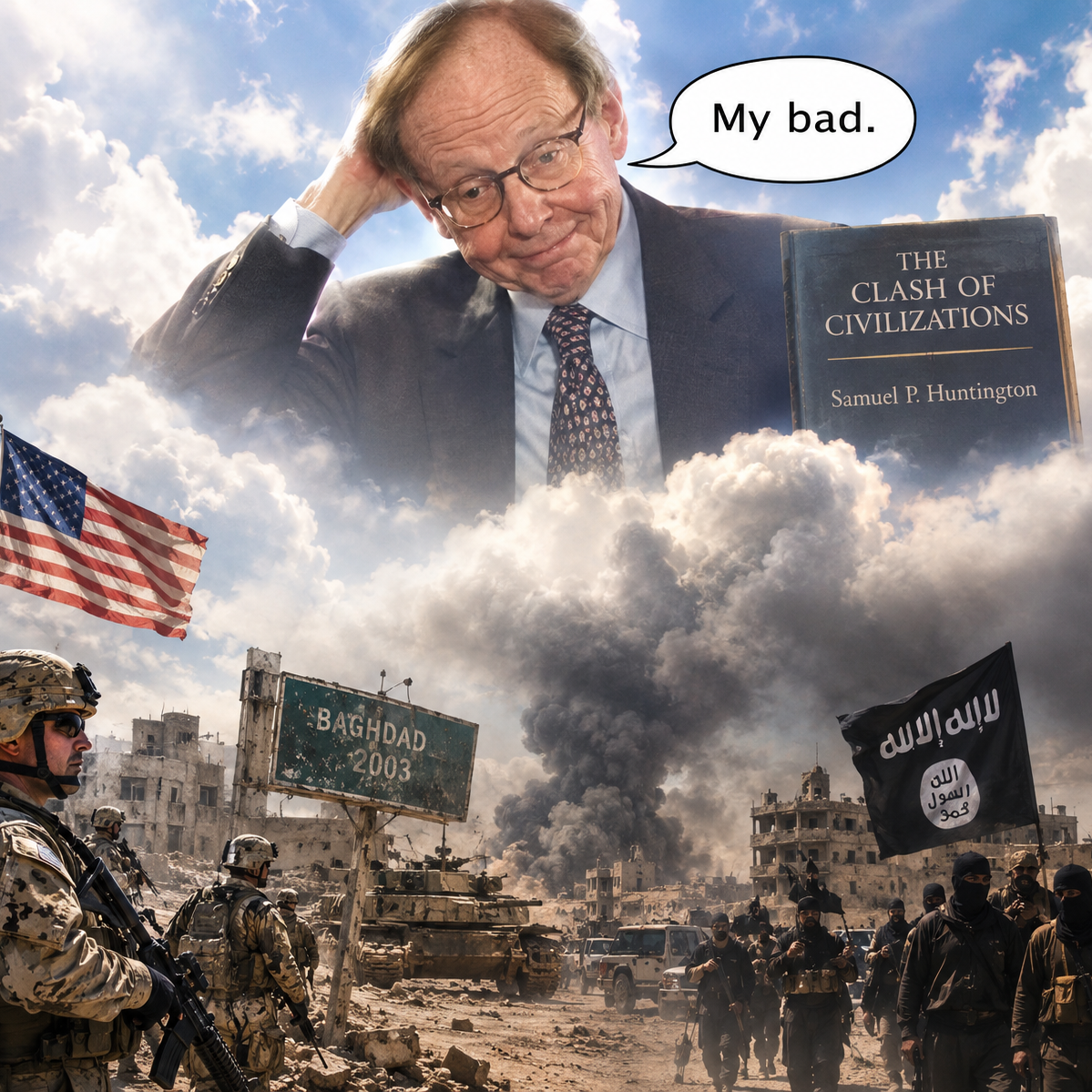
An image generated by ChatGPT that imagines Samuel Huntington in the afterlife regretting how his thesis ended up influencing world events.
Conclusion
“The Clash of Civilizations?” essay, like many of the political think pieces that gained large popularity in the 1990s, presents itself to its readers as a guide for the future. Unlike Fukuyama and many other American intellectuals of his time, Huntington attempts to legitimize his thesis on historical grounds. More than that, he makes the daring claim that the realities of the coming wars will echo the standard pattern of identity-based conflict that he argues defined most of human history.
In reality, the vast majority of Huntington’s essay focuses on contemporary politics. Huntington spends far more effort analyzing the political developments in Turkey, Mexico, and Russia in the immediate aftermath of the Cold War’s end than he does exemplifying his understanding of human history writ large. However, by resting his thesis on a summary that encompasses the bulk of history, Huntington exposes the Clash of Civilizations argument to case studies drawn from any time period of human activity.
As this paper has demonstrated, ancient Assyria and Babylonia constituted two members of a common civilization in Mesopotamia according to the definitional parameters of civilization that Huntington lays out for his readers. Per Huntington’s concept of kin-country syndrome, the two polities, regardless of whatever animosities and differences existed between them, should have rallied to each other’s support when confronted by foreign peoples outside of their civilizational identity. In fact, the very opposite happened.
Not only did both Assyria and Babylonia ally with powers outside their own civilization to fight each other in the 610s BC/BCE, but the Babylonian-Median coalition eventually eradicated the Assyrian Empire from existence. The Babylonians destroyed their Assyrian cousins, and they did so in a war that had profound consequences for the politics of the time and even up until today. Thus, the history of Assyro-Babylonian relations contradicts the basic premises of the Clash of Civilizations hypothesis.
Huntington’s thesis should best be valued as a window into the attitudes and thinking of the early 1990s rather than a prophecy of the future. For his prediction relies on a perceived explanation of the past that, when actually challenged, does not hold firm against case studies like Assyria vs. Babylonia. Whereas Huntington’s thesis could be applied successfully in select historical instances, the Assyro-Babylonian example has illuminated its weakness as a tutorial for general history and therefore as a guide to the Post-Cold War Era. In this paper’s last reference to Frahm’s thoughts, we should consider that civil wars are just as likely to produce totalizing destruction and pivotal moments of human history as so-called “civilizational clashes” (Frahm 2023, 282).
Civil wars are often more “total” than conventional conflicts between nations. The private becomes political in them and the political private. The conflict between Ashurbanipal and Shamash-shumu-kin, fought from 652 to 648 BCE, provides a good example. (Frahm 2023, 282)
More so than even the war between Ashurbanipal and Shamash-shum-ukin, the civil war within the Assyro-Babylonian civilization during the 620s and 610s BC/BCE forever changed world history.
Before we conclude, there is one final matter to discuss. Far from being a mere intellectual piece, Huntington’s essay did have profound influence in the thinking towards the Islamic world and Middle East. Drawing from a 1990 essay by Bernard Lewis titled “The Roots of Muslim Rage,” Huntington devoted much of his paper to warnings of dangers from the Islamic world (Smith 2023). Without actually providing an in-depth rationale, he believed that the most violent civilization of the Post-Cold War Era would be Islam, and went as far as to write that, “Islam has bloody borders” (Huntington 1993). As we know from recent history, Huntington’s thesis would prove influential in shaping American attitudes towards Muslim countries following Al-Qaeda’s terrorist attacks on September 11, 2001 (Smith 2023).
Perceptions of Muslims as, in words from Lewis that Huntington quoted, the “ancient rival against our Judeo-Christian heritage, our secular present, and the worldwide expansion of both” (Huntington 1993) helped fuel the American-led invasion of Iraq in 2003. The instability that war caused in turn helped create conditions that later led to the rise of the Islamic State of Iraq and Syria, which, among numerous terroristic proclivities, delighted in destroying Assyrian and Babylonian artifacts (Frahm 2023, 409–23). We cannot wholly ascribe the war in Iraq and its consequences to Huntington’s essay, as numerous intellectuals and ideologues participated in demonizing Muslims and advocating for the 2003 invasion. Nevertheless, Huntington’s essay certainly had an influence (Smith 2023).
If there is anything that professional Assyriologists and students of Assyrian and Babylonian history can do in service of the ancient peoples and culture they study, it would arguably be to help dismiss political ideas that help create conditions that ultimately threaten the material legacy of ancient Mesopotamia and the well-being of the people in present-day Iraq and Syria.
References (Chicago Manual of Style 18th edition, author-date)
Cogan, Mordechai. 2013. Bound for Exile: Israelites and Judeans Under Imperial Yoke: Documents from Assyria and Babylonia. Carta Jerusalem.
Cogan, Mordechai. 2015. The Raging Torrent, Second Edition: Updated and Expanded. Carta Jerusalem.
Electronic Babylonian Library. n.d. “Poem of Creation (Enūma Eliš) Chapter IV: Text Edition in the Electronic Babylonian Library.” Accessed September 20, 2026. https://www.ebl.lmu.de/corpus/L/1/2/SB/IV.
Frahm, Eckart. 2023. Assyria: The Rise and Fall of the World’s First Empire. Basic Books.
Frame, Grant. 1992. Babylonia 689–627 B.C.: A Political History. Istanbul: Nederlands Historisch-Archaeologisch Instituut.
Huntington, Samuel P. 1993. “The Clash of Civilizations?” Foreign Affairs, June 1. https://www.foreignaffairs.com/articles/united-states/1993-06-01/clash-civilizations.
Jastrow Jr., Morris. 1915. The Civilization of Babylonia and Assyria: Its Remains, Language, History, Religion, Commerce, Law, Art, and Literature. Forgotten Books.
Melammu Project. n.d. “Descriptions of Battle (1).” Accessed September 20, 2026. http://www.melammu-project.eu/database/gen_html/a0001257.html.
Oracc/SAAo. n.d. “The Sin of Sargon.” Accessed September 20, 2026. https://oracc.museum.upenn.edu/saao/saa03/P336604.
Schramm, Albert. 1925. Siegesstele des Königs Assarhaddon. aus dem Buch: “Das Deutsche Buchmuseum zu Leipzig” von Albert Schramm. https://commons.wikimedia.org/wiki/File:Das_Deutsche_Buchmuseum_zu_Leipzig_062.jpg.
Smith, Jordan Michael. 2023. “Samuel Huntington’s Great Idea Was Totally Wrong.” The New Republic, October 19. https://newrepublic.com/article/176019/samuel-huntington-clash-civilizations-wrong.
Staatliche Museen zu Berlin, Vorderasiatisches Museum. n.d. “Victory Stele of King Esarhaddon - Unknown.” Accessed September 21, 2026. https://artsandculture.google.com/asset/victory-stele-of-king-esarhaddon-unknown/VQEu-T-wE5Tf7w.